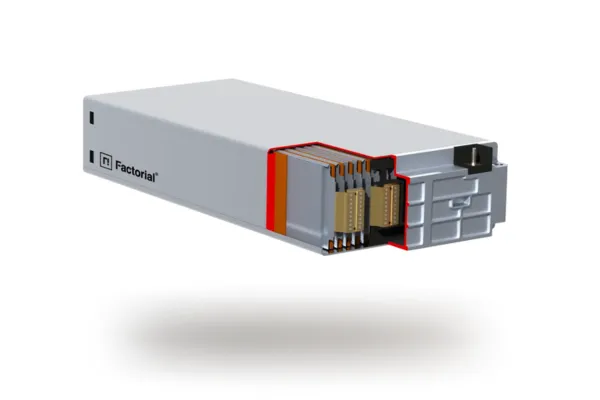
Factorial’s Solid-State SPAC: A Boston-Area Battery Bet That Could Reshape EV Range — and Eventually Building Power
Factorial Energy, a solid-state battery developer based in the Boston area, is taking a swing at the public markets — not with a traditional IPO, but by merging with a SPAC. The deal is the latest signal that investors and automakers still want a “next battery wave,” even as near-term EV adoption in the U.S. looks more incremental than explosive.
For commercial real estate owners and planners, the headline isn’t “745 miles on a charge.” It’s what comes after: how quickly (or slowly) next-gen batteries move from test vehicles into real fleets — and what that does to charging demand, electrical upgrades and the long-term economics of electrification on your properties.
The Deal: A $1.1 Billion Valuation and a Mid-2026 Market Debut
Factorial said it has a definitive business combination agreement with Cartesian Growth Corp. III, a special purpose acquisition company. The transaction values Factorial at about $1.1 billion on a pre-money basis and includes $100 million in new capital via a private placement (PIPE). The SPAC also reported about $276 million in cash held in trust (subject to redemptions).
If the deal closes as planned, the combined company expects to list on Nasdaq under the ticker FAC, with timing targeted around mid-2026.
What Solid-State Promises — in Plain English
Most EVs today use lithium-ion batteries with a liquid electrolyte. Solid-state designs aim to replace that liquid with a solid (or quasi-solid) electrolyte, a shift developers say can improve safety and unlock higher energy density — which is a fancy way of saying more driving range for the same weight, or less battery for the same range. Factorial’s pitch to investors and automakers is built around those advantages — longer range, lighter packs and the potential for better charging performance.
The most attention-grabbing proof point so far: Mercedes-Benz reported a long-distance test run using a lightly modified EQS test vehicle equipped with a lithium-metal solid-state battery that traveled 1,205 kilometers (about 749 miles) from Stuttgart to Malmö without a charging stop, with 137 km of indicated remaining range at the end. Mercedes-Benz said the solid-state pack increased usable energy content by 25%, with weight and size comparable to a standard EQS battery.
Separately, Stellantis and Factorial have validated automotive-size cells and fast-charge capability in public statements — including a claim of charging from 15% to 90% in 18 minutes at room temperature for their validated cell format.
Why CRE Should Care: Range Changes Behavior, Not the Need for Charging
Here’s the real estate translation: if solid-state batteries eventually deliver meaningfully longer range and faster charging in production vehicles, it can change the charging “rhythm” on your properties — but it doesn’t remove the need to build charging.
Workplace and multifamily charging may become more “top-off” than “must-have.” Drivers with longer-range vehicles may charge less often, but when they do, they’ll still prefer convenient, predictable Level 2 access where they already park for hours.
Fast charging becomes more about throughput and experience. If future vehicles can take meaningful energy in shorter sessions, high-power sites will compete even more on uptime, layout and amenities — and less on simply being the only option.
The installed base still drives demand. Even if “next-gen” tech arrives, EVs and plug-in hybrids already on the road will keep using today’s charging standards for years. That means owners still need a practical plan for the equipment and tenant expectations that exist now.
Bottom line: solid-state is a future accelerator for electrification, not a reason to pause near-term charging buildouts.
OEM Validation Is the Story — and Factorial Is Stacking It
What makes Factorial’s announcement clickable (and investable) is the list of partners and public milestones:
Mercedes-Benz has publicly tied its road-testing program to Factorial cells based on FEST technology.
Stellantis said it plans to launch a demonstration fleet of Dodge Charger Daytona vehicles by 2026 using Factorial’s solid-state batteries — a key step because fleets force the technology to survive real-world duty cycles, not just lab benchmarks.
Factorial is also widening the upstream supply chain conversation. POSCO Future M announced an MOU with Factorial to cooperate on materials for all-solid-state batteries, explicitly linking EV batteries, robotics and energy storage systems as future end markets.
For U.S. owners and planners, this matters because it suggests the “battery industry” isn’t just an auto story — it’s a manufacturing and infrastructure story that can spill into stationary storage, microgrids and resilience planning over time.
The Reality Check: Scaling Is Still the Hard Part
If you’ve been around EVs for a while, you’ve seen this movie: a breakthrough gets announced, a commercialization timeline gets published, and then mass manufacturing proves slower than anyone wants.
Industry coverage of solid-state batteries has long highlighted the core issue: scaling from successful cells to reliable high-volume production introduces defects, yield problems and long qualification cycles. That “engineering step” is often where timelines stretch.
That’s also why the SPAC detail matters. Solid Power — another solid-state developer — previously went public via a SPAC, underscoring how capital-market structures have become part of the battery commercialization tool kit. Factorial is essentially telling the market: we have enough OEM pull and technical proof points to fund the climb from “promising” to “manufacturable.”
What Building Owners Should Do With This Now
Treat Factorial’s SPAC as a signal, not a spec to design around:
Keep building charging for today’s vehicles — but design for change. Conduit, panel capacity planning and networking matter more than betting on one chemistry.
Watch for safety and permitting impacts. If solid-state eventually improves safety and energy density in stationary storage, it could expand where batteries can be economically deployed (including tighter urban footprints). But that’s later — and will still be governed by code, fire officials and insurers.
Expect “battery + building” convergence to keep accelerating. The same players and supply chains touching EV packs are increasingly relevant to behind-the-meter storage. POSCO’s language explicitly ties solid-state development to energy storage systems, not just cars.
Conclusion: A Real Milestone — and a Reminder to Stay Practical
Factorial’s planned public debut is a legitimate milestone: a Massachusetts-based company with named OEM partners is raising capital to push solid-state batteries toward the second half of this decade.
For real estate portfolios, the strategy stays grounded: electrification is not one technology, one charger type or one battery chemistry. Every building, site and campus has different tenants, tariffs, peak loads, parking patterns and grid constraints — and the winning approach is a custom plan that uses all the tools available: make-ready design, managed Level 2 charging, selective fast charging where it pencils, and storage and controls where the rate structure rewards it.
