The $156 Billion Backlash and the Planning Profession's Dual Role
Nearly 400 Opposition Groups Across 42 States, 238 Legislative Proposals, and a Bipartisan Voter Realignment Rewrite the Siting Playbook
By Keith Reynolds | Publisher & Editor, ChargedUp!
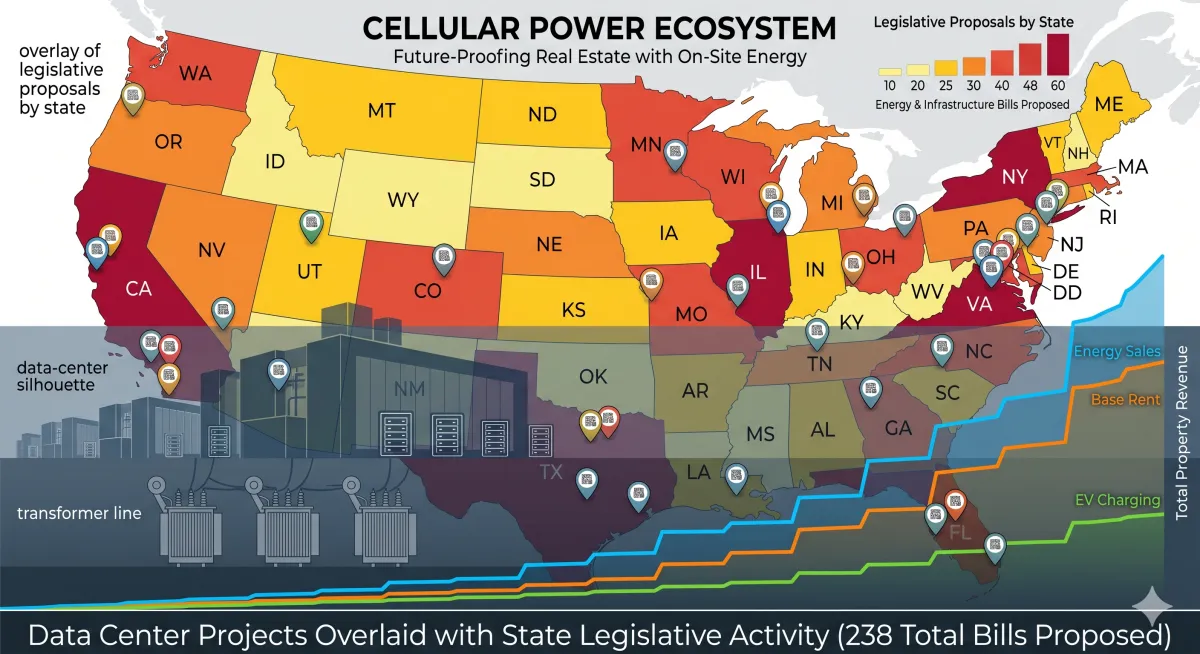
The 10a Labs-backed Data Center Watch research program has documented 48 data center projects that were either blocked outright or stalled through 2025, representing a combined $156 billion in planned investment. That figure is up from $98 billion counted in Q2 2025 alone and from $64 billion across the two-year period ending March 2025. The number of grassroots opposition groups has doubled over the past year to nearly 400, with 57 active groups in Virginia alone. State legislatures considered 238 proposals to restrict data center development in 2025, and 40 of those proposals became law.
On April 14, 2026, the Maine Senate took its final vote on LD 307, sending the nation's first statewide data center moratorium to Governor Janet Mills' desk. The bill prohibits municipalities, state agencies, and quasi-independent entities from issuing any approval for a data center with a load of 20 megawatts or more through November 2027. It also creates the Maine Data Center Coordination Council to study risks, benefits, and policy tools. Final House passage was 79 to 62 on April 8; the Senate moved on April 14 with a 21 to 13 vote. The governor has 10 days from transmittal to sign, veto, or allow the bill to become law without her signature. Mills has signaled concerns about the absence of a carveout for a proposed 82-megawatt Sentinel Data Centers project at the former Androscoggin mill site in Jay, but the legislature rejected an amendment that would have created an exemption process.
The Bipartisan Profile Makes This Structural
Data Center Watch's review of elected officials who took public positions against large data center projects found 55 percent Republican and 45 percent Democratic. That split is the reason this opposition wave is not cyclical. Rural conservatives focus on property rights, local land use control, and utility cost pass-throughs. Progressive advocates focus on environmental review, water consumption, and ratepayer equity. Both coalitions are converging on the same regulatory asks: mandatory impact assessment, separate rate classes for large loads, public disclosure of water draw and energy use, and meaningful municipal veto power over hyperscale siting decisions.
The Harvard Gazette published an interview on April 10 with University of Michigan assistant professor Ben Green that frames the political realignment directly. Green argues that data center opposition is now a winning campaign issue for candidates in Virginia, Georgia, New Jersey, and Michigan, and that the 2026 midterm strategy in Pennsylvania, North Carolina, and Georgia has begun to incorporate it. A March Quinnipiac national poll found that 65 percent of Americans oppose the construction of AI data centers in their communities, with 24 percent supporting them. Among opponents, 72 percent cited electricity costs as a primary reason, 64 percent cited water use, and 41 percent cited noise.
Virginia remains the leading indicator. Voter support for new data centers in the commonwealth collapsed from 69 percent in 2023 to 35 percent in the most recent polling. Candidates who supported large projects were voted out in Warrenton and in other Prince William County races. The QTS and Compass Digital Gateway project in Prince William continues to face sustained legal challenges from the Piedmont Environmental Council and the Coalition to Protect Prince William County. The county committed an additional $400,000 to defend the project in appeals court, and oral arguments before the Virginia Court of Appeals began the week of February 23, 2026.
What This Means for Underwriting
The $156 billion figure signals that every pro forma tied to large-load development should account for the probability of entitlement delay or outright project cancellation. Construction financing, equity returns, tenant letters of intent, and utility interconnection deposits are all exposed to a political risk that was not priced in two years ago. For CRE investors providing land, shell space, or adjacent infrastructure, the exposure runs through the speculative site-selection phase into the operational phase, where a project that clears zoning can still face a later ballot initiative or a subsequent moratorium.
Sanford, North Carolina, has produced what is arguably the most complete model zoning framework of this cycle. The draft ordinance establishes a 500-foot residential setback, a 75-foot height limit, a 65-decibel noise cap, $10,000-per-violation fines for exceedances, and a mandatory utility will-serve letter before a building permit can issue. The April 21 public hearing is worth tracking for planners drafting comparable language in their own jurisdictions. The Good Jobs First moratorium tracker reports active proposals in at least 24 states, with the number of localities pursuing similar measures expanding quarter over quarter.
Planners’ Dual Roles at NPC26
Planners will represent two perspectives at this week's National Planning Conference: the facilitators facing organized community opposition in their home jurisdictions, and the professionals looking for tools, frameworks, and peer conversations to navigate toward solutions. These two roles are not in conflict with one another, rather, they are each part of the same job. The ChargedUp! Pavilion taking place during the event is structured around that reality. Ratepayer cost allocation, model zoning language, will-serve letter protocols, water consumption disclosure, and economic development math all land on the same desk. We’ve designed the pavilion to help planners, owners, utility staff, and infrastructure providers work through these shared issues together rather than across a negotiating table. Looking forward to seeing you there.
Sources and Further Reading
ChargedUp! NPC26 Pavilion information: https://chargeduppro.com/chargedup-pavilion
Data Center Watch, 2025 Annual Report: https://www.datacenterwatch.org/report
Data Center Watch, Q3-Q4 2025 Update: https://www.datacenterwatch.org/q3-q4-2025
Good Jobs First, data center moratorium bills tracker: https://goodjobsfirst.org/data-center-moratorium-bills-are-spreading-in-2026/
Harvard Gazette, interview with Ben Green on data center opposition: https://news.harvard.edu/gazette/story/2026/04/why-are-communities-pushing-back-against-data-centers/
Lawfare, "How AI Data Centers Are Shaping Politics": https://www.lawfaremedia.org/article/how-ai-data-centers-are-shaping-politics
Maine Morning Star, "Landmark data center moratorium passes Maine Legislature": https://mainemorningstar.com/2026/04/09/landmark-data-center-moratorium-passes-maine-legislature/
Portland Press Herald, "Maine lawmakers approve first-in-nation ban on data centers": (April 14, 2026) https://www.pressherald.com/2026/04/14/maine-lawmakers-approve-first-in-nation-ban-on-data-centers-2/
Tom's Hardware, "Virginia voter support for new data centers collapses to 35 percent": https://www.tomshardware.com/tech-industry/virginia-voter-support-for-new-data-centers-collapses-to-35-percent
