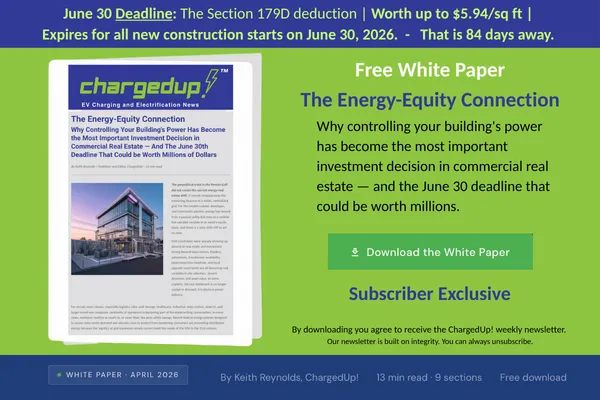
Subscriber Exclusive White Paper Preview: The Energy-Equity Connection
Controlling Your Building’s Power Has Become the Most Important Investment Decision in Commercial Real Estate - An Upcoming June 30th Deadline That Could be Worth Millions of Dollars.
>> FREE DOWNLOAD HERE (No forms or landing pages.)
By Keith Reynolds | Publisher & Editor, ChargedUp!
The following post is an executive summary of our recently published white paper, The Energy Equity Connection: Why Controlling Your Building's Power Has Become the Most Important Investment Decision in Commercial Real Estate.
For the modern owner, developer, and community planner, energy has moved from a passive utility line item to a volatile but valuable NOI variable in an asset’s equity stack. With the expiration of 179D deduction, there is a June 30th cliff to act on now that could be worth millions.
This white paper is available as an exclusive for all current and new subscribers of our weekly newsletter. Subscribe today to read the full piece.
The geopolitical crisis in the Persian Gulf did not create the current energy-real estate shift; it merely stripped away the remaining illusions of a stable, centralized grid. For the modern owner, developer, and community planner, energy has moved from a passive utility line item to a volatile but valuable variable in an asset’s equity stack, and there is a June 30th cliff to act on now.
The Structural Reality: A Grid at Its Limit
Even before the events of February 28th, the American grid was failing. With 70% of infrastructure past its design life and transformer lead times stretching to five years, the system was already unable to meet the triple threat of 2026: AI data centers, EV fleet migration, and industrial reshoring. Interconnection queues of five to ten years and a tenfold spike in PJM capacity prices prove that the centralized model has reached a physical and economic ceiling.
The New Political Inevitability
A rare non-partisan engineering consensus has emerged. Whether through the prior administration’s tax incentives or the current White House’s National Policy Framework for Artificial Intelligence, the conclusion is identical: the grid cannot grow fast enough. Both sides of the aisle are now prioritizing onsite generation and requiring large-load users (data centers) to pay their own way. We are moving toward a cellular power architecture where imbalances are resolved at the building level first.
The Financial Transmission: From Hormuz to the Heartland
The "Energy-Equity Connection" operates through a direct, six-step financial chain:
Mideast Energy War Shocks drive massive, unbudgeted government spending.
Fiscal Stress causes bond investors to demand higher yields on U.S. Treasuries.
The 10-Year Treasury acts as the floor for all commercial real estate pricing.
Cap Rates Expand as the risk-free rate rises, compressing asset values across the board.
NOI Is the Only Lever: In an environment of expanding cap rates, every dollar saved in energy costs is amplified. At an 8% cap rate, $1,000 in annual savings adds $12,500 in asset value. Energy cost reduction is no longer just about sustainability - it has become a valuation defense.
Expiration of the Section 179D tax deduction June 30, 2026 increases the price of inaction.
The Strategy for Owners and Planners
The window to act is narrow and defined by a compounding clock:
For Owners: The Section 179D tax deduction (now $5.94/sq ft) and 100% bonus depreciation provide a massive incentive stack, but only for projects starting before June 30, 2026.
For Planners: Local governance is the ultimate variable. Communities that conduct zoning audits to remove obstacles for solar and storage, and those that integrate Virtual Power Plants (VPPs) into their comprehensive plans, will capture the capital currently fleeing less energy resilient jurisdictions. See white paper Section 7 “What Planners Can Do - and Why It Matters for Everyone”, for further insights and strategies.
The Cost of Waiting
The right upgrades can make a building VPP-ready, potentially qualifying it for a utility, aggregator, or market program. In practice, eligibility depends on the asset mix, interconnection status, metering, telemetry, dispatchability, and program design. The building still has to fit local market and program rules.
It is definitely worth exploring. For a typical Class-A office asset in a PJM market (where capacity prices have spiked), the difference between starting an energy project on June 29th vs. July 1st is a permanent 15% to 25% increase in the total net cost of the project.
In a market where asset values are already being repriced downward due to the Strait of Hormuz Risk Premium, losing a half-million-dollar tax benefit on a single 100,000 square ft asset is often the difference between an investable property and a distressed one. The directive for developers and planners is clear. If you don't have a shovel in the ground or 5% of project capital committed by June 30th, you are effectively choosing to pay a Grid Dependency Tax for the remainder of the decade.
The Bottom Line
The Qatar disruption has created a structural LNG deficit that will take 3 to 5 years to repair. High energy costs and grid volatility are the new baseline. The organizations that treat their buildings as active power plants - and secure equipment and tax credits before the June 30 cliff - will hold a competitive advantage that compounds every year. Meanwhile, those who wait for stability will let the market reprice their equity.
Read the Full White Paper
The full white paper PDF is available here as a newsletter subscriber exclusive. No forms or landing pages. What do you think? Send us your comments here.
Join the Conversation at NPC26
The ChargedUp! Pavilion at the American Planning Association's National Planning Conference
convenes this month in Detroit, April 25–28. Visit our event page to inquire about booth, kiosk, and speaking opportunities.
