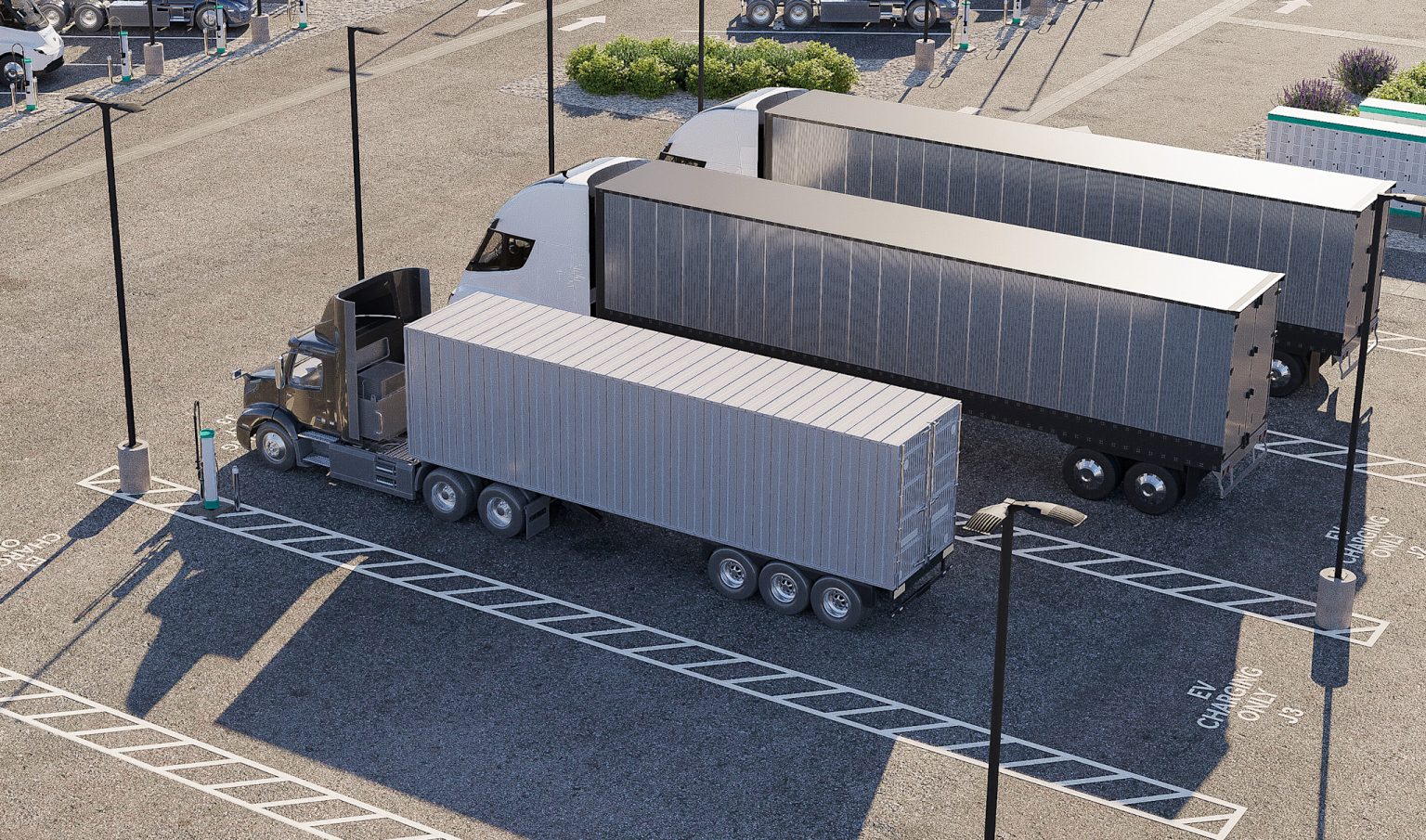
Inland Empire Hub Tests the Multi-Fleet Charging Model at Industrial Scale
EV Realty's 9 MW San Bernardino site puts shared infrastructure on the freight corridor that owns America's port flow. The implications run straight into industrial site selection.
By Keith Reynolds | Publisher & Editor, ChargedUp!
In April, EV Realty opened its flagship multi-fleet truck charging hub at 580 W. Mill Street in San Bernardino, California. The site features 76 high-power charging ports and 9 megawatts of capacity, sufficient to serve more than 200 medium- and heavy-duty trucks per day. It went from groundbreaking in mid-2025 to commercial operation in roughly nine months, an acceleration the company attributed to available grid power from Southern California Edison and a project team that included ParWest as construction partner. Initial customers are J.B. Hunt Transport, Gate City Beverage (a Reyes Holdings company), and all-electric carrier Nevoya.
The site sits less than a mile from the San Bernardino Intermodal Facility, surrounded by more than 60 million square feet of industrial warehouse space and within reach of Interstate 10 and Interstate 215. That geography is significant. The Inland Empire is where freight from the Ports of Los Angeles and Long Beach gets sorted and routed across the country. For owners of warehouse, distribution, and logistics-adjacent industrial properties anywhere on a major freight corridor, this site is now the operating template for what comes next.
The Shared Infrastructure Thesis Becomes Operational
The economic argument that fleets should not each build their own dedicated charging depots has been circulating for at least three years. The San Bernardino hub is the first commercial-scale test of whether a shared infrastructure operator can actually serve a national truckload carrier (J.B. Hunt), a regional beverage distributor (Gate City), and a pure-play electric carrier (Nevoya) on the same hardware, on the same site, simultaneously, at industrial throughput.
EV Realty calls the model Powered Properties. The company develops, owns, and operates the hubs and aggregates multiple fleets onto shared private infrastructure, citing lower costs versus fleets building and operating their own depots. The capital efficiency argument is straightforward. A 200-truck-per-day charging hub built once can service the daily energy needs of multiple carriers whose duty cycles do not perfectly overlap. A fleet-by-fleet approach would require each carrier to size its depot for its own peak, which means most of the connected capacity sits unused most of the time.
For industrial property owners, the implication is direct. If shared truck charging works at this scale, then the location decision for warehouse and distribution real estate near major freight corridors changes. Sites within practical drayage distance of a Powered Property hub gain optionality. Sites without nearby high-power charging access lose it. Tenant underwriting now has to address whether a logistics tenant's electrification plan has a credible charging endpoint inside the operating radius of the property.
Megawatt Charging Arrives, with Hardware to Match
The hub deploys Kempower charging hardware: 74 Kempower Satellites for CCS charging up to 500 kW, plus two Kempower Mega Satellites that deliver up to 1.2 MW per dispenser using the Megawatt Charging System (MCS) standard. MCS is the emerging standard for charging at power levels above 1 MW, designed specifically for next-generation Class 8 tractors. Spring-assisted cables address driver ergonomics for the heavier MCS connectors.
In late March 2026, Kempower, Windrose, and EV Realty completed the first successful MCS charging session in North America at the same San Bernardino site, validating that the hardware works under real-world conditions ahead of commercial opening. Software from Synop manages power, reservations, reporting, and fleet insights covering cost, range, and efficiency. The site operates 24/7 with on-site staff, security, parking, and driver amenities.
The dual-standard configuration matters because the heavy-duty truck fleet does not turn over in a single year. Class 8 tractors purchased in 2024 and 2025 use CCS at 350 kW to 500 kW. MCS-capable trucks from Volvo, Daimler, and other manufacturers are reaching the road in volume during 2026. A hub that supports both standards can serve a mixed fleet today and a fully MCS fleet in 2030 without a rebuild.
What This Tells Industrial Property Owners
The first signal: time-to-power is now the rate-limiting factor for industrial leasing on freight corridors. Southern California Edison delivered power to the San Bernardino site fast enough to support a nine-month construction schedule. That is the exception, not the rule. In most PJM and MISO territory, transformer lead times stretch past three years and queue positions for new industrial loads are constrained. Industrial sites that already have utility-confirmed capacity sufficient to host either a multi-fleet hub or a tenant's private depot now command a premium that did not exist eighteen months ago.
The second signal: shared infrastructure changes the calculus for build-to-suit industrial development. A developer underwriting a 500,000-square-foot logistics box no longer has to assume the tenant will install and operate its own charging. The presence or absence of a Powered Property hub within drayage range becomes part of the site's pro forma. Sites within a credible operating radius can lease faster and at higher rents. Sites outside that radius face a longer absorption schedule because the tenant must self-fund both the building and the energy infrastructure.
The third signal: utility partnership quality is now an underwriting variable. The San Bernardino site closed because Southern California Edison could deliver. Industrial parks served by utilities with shorter interconnection queues, more transformer inventory, and clearer behind-the-meter rules will out-compete identical sites in slower territories. This is not abstract. Construction was supported by grants from the South Coast Air Quality Management District's Carl Moyer Program and the California Energy Commission's EnergIIZE Commercial Vehicles Project, which means California is also subsidizing freight electrification on top of utility delivery. Other states are watching.
The Customer Roster Tells the Story
J.B. Hunt is one of the largest truckload carriers in the United States with a national footprint. Gate City Beverage is a regional distributor handling beer and wine across the Inland Empire and parts of Los Angeles County. Nevoya is a fully electric carrier that has been expanding rapidly under California's drayage truck rules. The mix matters because it shows the shared-hub model is not a niche play for environmental early adopters. A national carrier whose operating margin depends on truck utilization is willing to use the same plug as a regional beverage distributor and an all-electric upstart, on shared infrastructure, because the unit economics work.
Nevoya Chief Commercial Officer John Verdon framed the operational benefit in a statement at the opening, noting that the site provides operational flexibility with both megawatt charging and vehicle domicile options. EV Realty CEO Patrick Sullivan said fleets in the Inland Empire are doing some of the most demanding work in the supply chain and need reliable, affordable access to high-power charging to move beyond pilots and make electrification a real business decision.
The Underwriting Implication
For owners of industrial real estate within 50 miles of a major freight corridor, three questions now need answers before a 2027 lease renewal. First, is there a Powered Properties hub or equivalent multi-fleet charging facility within practical operating distance? Second, what is the local utility's actual delivered timeline for a 5 MW to 10 MW interconnection on similar industrial parcels? Third, does the property's existing electrical service support a tenant adding private fast-charging without triggering a utility-side upgrade that runs past the lease term?
The answers reshape acquisition pricing, lease economics, and capital allocation. Sites with a yes-yes-yes profile underwrite at compressed cap rates relative to identical buildings without the energy infrastructure access. Sites with a no-no-no profile face faster economic obsolescence as logistics tenants electrify under California Air Resources Board rules and corporate fleet commitments.
EV Realty is not the only company building this model. WattEV operates a competing depot less than ten miles away, expanded its San Bernardino facility in February 2026 with 30 additional CCS connectors and six MCS connectors, and reports averaging approximately 700 megawatt-hours per month of utilization. Tesla has 66 Semi charging locations operational or planned across major freight corridors, with 19 in Texas and 17 in California. The infrastructure is being built. The question for industrial property owners is whether their assets are positioned to capture the leasing premium that follows.
The June 30, 2026 sunset of the Section 30C Alternative Fuel Vehicle Refueling Property Credit accelerates this calculus. Charging infrastructure that begins construction after that date loses access to the 30 percent credit (with prevailing wage and apprenticeship). For developers underwriting industrial sites with onsite charging, the next sixty days are the operative window.
Sources
Electrek coverage of opening — https://electrek.co/2026/04/09/76-chargers-9-mw-a-huge-ev-truck-charging-hub-opens-where-us-freight-actually-runs/
EV Realty press release on San Bernardino opening (April 9, 2026) — https://www.globenewswire.com/news-release/2026/04/09/3271033/0/en/EV-Realty-Opens-Major-Truck-Charging-Hub-in-California-s-Inland-Empire-with-76-Ports-and-9-MW-of-Capacity.html
First North American MCS session validated (March 2026) — https://electrek.co/2026/03/26/this-chargers-first-megawatt-truck-charge-hits-north-america/
FreightWaves analysis of multi-fleet model — https://www.freightwaves.com/news/ev-realty-opens-major-truck-charging-hub-san-bernardino
Kempower investor announcement (April 9, 2026) — https://investors.kempower.com/releases/ev-realtys-major-truck-charging-hub-featuring-kempower-charging-solutions-opens-in-california/
WattEV San Bernardino expansion (Electrive, February 2026) — https://www.electrive.com/2026/02/09/wattev-expands-san-bernardino-depot-with-megawatt-charging/
