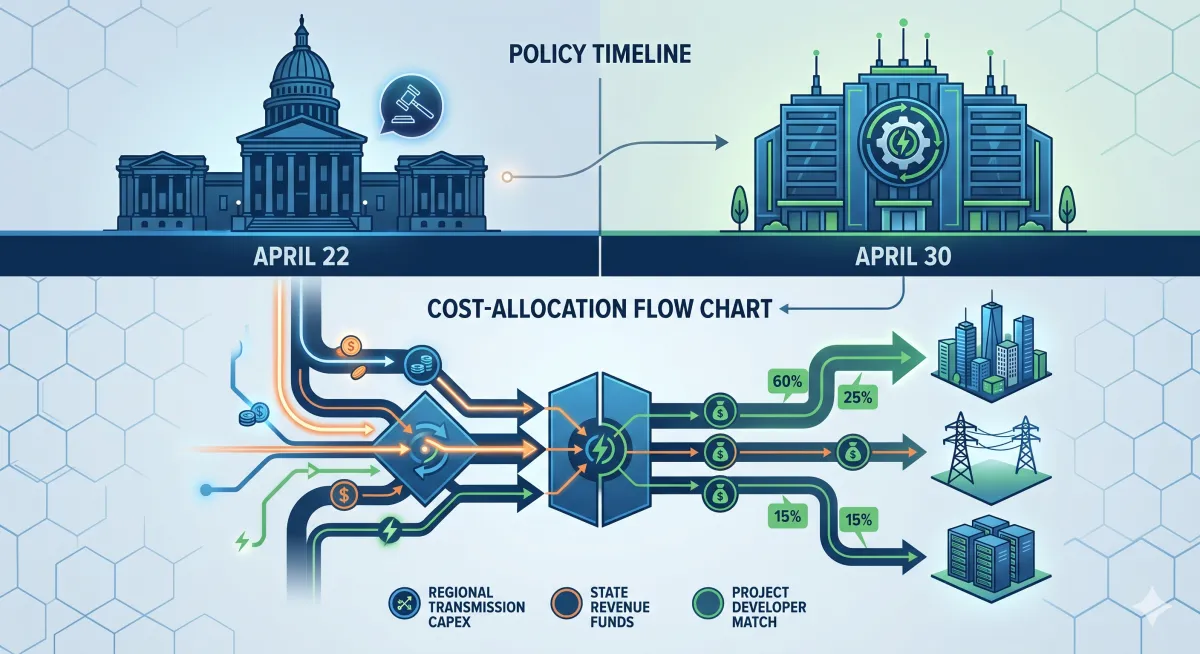
FERC Final Rule and Virginia Veto Session Land in the Same Week, Rewriting the Data Center Cost Map
April 22 Virginia Legislative Return and April 30 FERC Deadline Set New Federal and State Precedent on Who Pays for Grid Upgrades
By Keith Reynolds | Publisher & Editor, ChargedUp!
Two policy inflection points landing inside a single seven-day window together define the cost-allocation fight for the next decade.
On April 22, the Virginia General Assembly returns to Richmond for its reconvened session to act on Governor Abigail Spanberger's amendments to 176 bills and her vetoes of eight. Among the amended legislation are Senate Bill 253 and House Bill 1393, the data center cost-shift measures sponsored by Senate President Pro Tempore Louise Lucas, Democrat of Portsmouth, and Delegate Destiny LeVere Bolling, Democrat of Henrico. Eight days later, on April 30, the Federal Energy Regulatory Commission faces the Department of Energy-directed deadline for final action on docket RM26-4-000, the Advance Notice of Proposed Rulemaking on large-load interconnection.
The proposed FERC framework would assert federal jurisdiction over the interconnection of loads greater than 20 megawatts directly to the interstate transmission system and apply a 100 percent participant funding model, meaning data center operators and other large-load customers would pay the full cost of grid network upgrades triggered by their interconnection rather than socializing those costs across all ratepayers. The Virginia legislation would direct the State Corporation Commission to create a new GS-5 rate class covering data centers and to consider whether infrastructure costs built specifically for those facilities should fall on that class rather than on residential ratepayers.
The Virginia Picture Heading Into April 22
The underlying Virginia fight is substantial. The state's data center sales and use tax exemption saved the industry nearly $2 billion in the last fiscal year alone. Senator Lucas has pushed to sunset that exemption by January 2027, ahead of its scheduled 2035 expiration. Governor Spanberger and the House of Delegates maintain support for the exemption. The two chambers have not reached agreement on a biennium budget, which makes the April 23 special budget session, immediately following the April 22 reconvened session, structurally connected to the data center policy debate. Senator Scott Surovell has publicly expressed skepticism that a budget will be finalized on April 23.
Spanberger's amendments to SB 253 and HB 1393 stripped the explicit cost-shift mechanism that legislators had built in to direct approximately $5.52 per month in residential customer savings. Critics, including Lucas and LeVere Bolling, argue that the amendments weaken the bills substantially. Spanberger's office argues that the amendments retain the core structural reforms, including the retroactive limitation on Dominion Energy Virginia's authorized earnings in the current rate cycle, while avoiding constitutional questions about the SCC's authority. Legislators have three options: accept the amendments by majority vote, reject them and return the original bill to Spanberger for a 30-day signing decision, or override a veto if Spanberger ultimately vetoes the returned bill.
The Federal Picture Heading Into April 30
The FERC proceeding is more consequential because it resets cost allocation across the entire PJM, ERCOT, MISO, and SPP footprints rather than a single state. The ANOPR was issued on October 23, 2025, by Secretary of Energy Chris Wright under Section 403 of the Department of Energy Organization Act. Comments closed December 5. The final action deadline of April 30 is aggressive for a rulemaking of this complexity, but the newly constituted FERC, with three Republican commissioners and two Democrats, is widely expected to meet it, even if the final action takes the form of an order articulating principles rather than a fully promulgated rule. A formal Notice of Proposed Rulemaking, followed by a Final Rule, would normally take an additional 12 to 24 months.
The cost-allocation principle is where the fight gets heated. The Edison Electric Institute has pressed for a 100-megawatt minimum threshold rather than the 20-megawatt threshold in the ANOPR, arguing that 20 megawatts captures too many mid-sized manufacturers and retail facilities that have historically been state-regulated. The Steel Manufacturers Association has warned that electric arc furnace mills cannot absorb interconnection costs on the same schedule as hyperscale data center developers, and has asked for crediting mechanisms that would offset network upgrade costs over time if the facility delivers systemwide benefits. The Center for Strategic and International Studies summarized the technical questions in a December 19 analysis worth reading in full.
The Signal for Property-Level Underwriting
The jurisdictional question matters directly at the property level because it determines whether the cost of extending the grid to a new large-load site lands on the project owner or on the surrounding community. Under the proposed FERC framework, a 200-megawatt data center developer pays for the network upgrades it triggers, and those costs appear in the project pro forma as a capital line item rather than in residential bills as a socialized pass-through. That changes the site-selection math. Jurisdictions with existing capacity headroom become substantially more attractive. Jurisdictions that require transmission buildouts become comparatively less attractive unless the developer can credibly absorb the cost.
For planners, the Virginia outcome sets the template for how every state with data center concentration writes its rate classes and tax structures. South Carolina and Maryland have already enacted rate negotiation laws. At least 18 states have introduced bills creating special rate classes for large energy users. The combination of federal cost-allocation reform through FERC and state-level rate class separation through legislation means the economic geography of large-load siting is being redrawn in real time. The jurisdictions that clarify their framework first will capture the capital that the current uncertainty is holding on the sidelines.
The twin April 22 and April 30 dates should be read as the beginning of this reset rather than the end of it. FERC's action on the 30th will almost certainly be appealed by one coalition or another. Virginia's reconvened session is the opening move in a multi-year fight over tax exemptions, cost allocation, and rate class design. Owners and planners who are reading this on publication day have a front-row seat to a structural realignment that will ripple through property-level economics for the rest of the decade.
Sources and Further Reading
CSIS, "What's at Stake in FERC's Large Load Proposal?" https://www.csis.org/analysis/whats-stake-fercs-large-load-proposal
Engineering News-Record, "Power Sector Debates New Federal Rules for Data Center Large Load Links to Grid" https://www.enr.com/articles/62219-power-sector-debates-new-federal-rules-for-data-center-large-load-links-to-grid
FERC, docket RM26-4-000 landing page https://www.ferc.gov/rm26-4
Mayer Brown, "FERC Large-Load Interconnection Preliminary Rulemaking: Key Takeaways" https://www.mayerbrown.com/en/insights/publications/2025/11/ferc-large-load-interconnection-preliminary-rulemaking-key-takeaways-for-data-center-developers-other-large-load-projects-and-investors
MultiState Associates, "Virginia lawmakers pass 15 data center bills as tax exemption fight looms" https://www.multistate.us/insider/2026/3/30/virginia-lawmakers-pass-15-data-center-bills-as-tax-exemption-fight-looms
Piedmont Environmental Council, 2026 data center reform legislation summary https://www.pecva.org/region/regional-state-national-region/2026-data-center-reform-legislation/
Virginia Mercury, "Governor amends bills that shift costs onto data centers" https://virginiamercury.com/2026/04/16/lawmakers-dominion-say-spanbergers-amendments-weaken-bill-to-shift-costs-onto-data-centers/
White and Case, "DOE directs FERC to accelerate interconnection of data centers" https://www.whitecase.com/insight-alert/doe-directs-ferc-accelerate-interconnection-data-centers
