Ford Energy Turns EV Battery Overcapacity Into a 20-Gigawatt-Hour Bet on the Grid
By Keith Reynolds | Publisher & Editor, ChargedUp!
Ford Motor Company has formally launched Ford Energy, a wholly owned subsidiary that will manufacture and sell United States–assembled battery energy storage systems for utilities, data centers, and large industrial and commercial customers, with first deliveries targeted for late 2027. On May 18, Ford Energy announced a five-year framework agreement with EDF Power Solutions for up to 20 gigawatt-hours of supply, structured as up to 4 gigawatt-hours per year.
The launch tells building owners, industrial developers, and capital allocators where battery production capacity is now flowing.
From EV overcapacity to grid-scale storage
Ford built the Kentucky and Michigan battery plants to feed an electric vehicle program that did not absorb the capacity. In December 2025, Ford and SK On dissolved their $11.4 billion BlueOval SK joint venture, splitting the factories between the two companies. Within weeks, Ford signaled that it would convert the recovered capacity to grid-scale battery energy storage rather than scale back production. The Ford Energy subsidiary is the formal commercial expression of that pivot.
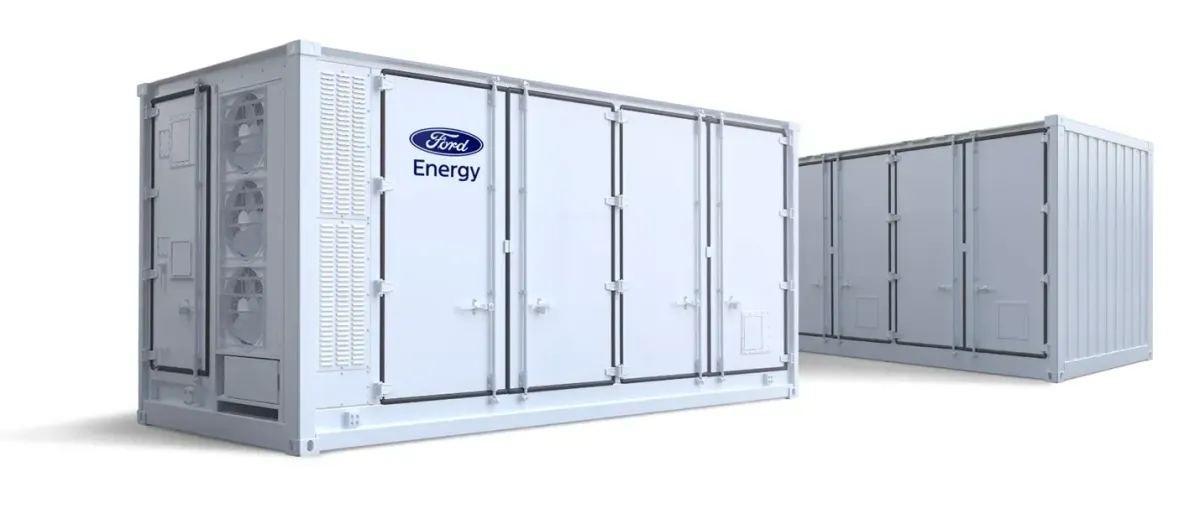
The flagship product, branded the Ford Energy DC Block, is a standardized 20-foot containerized system built around 512-ampere-hour lithium iron phosphate prismatic cells. LFP chemistry dominates the stationary storage market for two reasons that matter to commercial real estate: lower fire risk than nickel manganese cobalt chemistries, and longer cycle life under the daily charge-discharge patterns that data centers, industrial campuses, and behind-the-meter installations require.
Market context
The United States is projected to add approximately 24 gigawatts of new utility-scale battery storage in 2026, nearly double the 15 gigawatts deployed in 2025. Ford Energy's 20-gigawatt-hour annual production target, when it reaches full output, would represent meaningful domestic supply against industry projections of more than 600 gigawatt-hours of storage on the U.S. grid by 2030. Data center demand is the largest single driver. Industry analysis suggests that data centers could account for 83% of behind-the-meter commercial and industrial storage deployments by 2030.
BloombergNEF's most recent Energy Storage Systems Cost Survey put the global average turnkey BESS price at $117 per kilowatt-hour for 2025, a 31% decline year-over-year. Four-hour duration systems averaged $110 per kilowatt-hour. Ember's parallel analysis pegged all-inclusive capital expenditure at $125 per kilowatt-hour across global markets excluding China and the United States, with core equipment from China at roughly $75 per kilowatt-hour and installation and connection at the remaining $50. Ford Energy enters that market with a domestic content proposition that aims at the federal tax credit framework while the credits remain available.
Why the launch matters for buildings
The framing inside Ford's announcement is utility scale. Lisa Drake, the executive leading the new subsidiary, has emphasized data centers and large industrial customers as primary targets. Additional use cases include:
Industrial and logistics. Prologis's 2026 Supply Chain Outlook reported that 90% of supply chain leaders surveyed said they would pay a premium for sites with reliable energy infrastructure. Behind-the-meter storage paired with onsite solar, gas reciprocating engines, or grid imports during off-peak hours moves from optional resilience feature to a lease consideration. Owners of distribution warehouses, cold storage facilities, and advanced manufacturing campuses now have a domestic-content storage option entering the supply chain.
Healthcare and life sciences. Hospital systems, biopharma campuses, and life sciences research facilities operate critical loads that have historically been served by diesel generators. Battery energy storage paired with photovoltaic generation and grid connection offers a quieter, lower-emission alternative that also generates revenue through demand response and capacity market participation in restructured markets.
Multifamily and mixed-use. Larger multifamily portfolios in deregulated markets are increasingly evaluating storage as a hedge against demand charges and a participation vehicle in virtual power plant programs. Ford Energy's containerized form factor, designed for utility-scale deployment, is too large for most multifamily applications, but its production volume signals broader commercial availability for the smaller systems that follow in the supply chain.
Class A office. Commercial office buildings with significant chiller plant loads, particularly in markets with capacity-driven demand charges, can use four-hour storage to shave peak demand and reduce house-meter charges that pass through to net operating income.
The signal beneath the deal
Ford Energy’s launch includes a five-year framework agreement with EDF Power Solutions, the U.S. renewables and storage development arm of Électricité de France, one of the largest utility-scale developers in North America. A multi-year supply commitment of this scale from EDF to a new entrant signals confidence in two things: that Ford Energy can deliver on quality and timeline, and that domestic content availability matters enough commercially to justify a multi-year procurement commitment outside the established Tesla, Fluence, Wartsila, and CATL supply chains. For building owners and developers, the EDF agreement validates Ford Energy as a credible counterparty for utility-scale and large commercial procurement.
The Treasury question
Ford Energy enters the market while Section 48E investment tax credits and 45X advanced manufacturing production credits remain available, though the policy framework continues to evolve. IRS Notice 2025-42, issued in September 2025, eliminated the 5% safe harbor for wind and solar generation projects under Sections 45Y and 48E, except for low-output solar of 1.5 megawatts or less, and required physical work as the sole pathway to beginning of construction status before the July 4, 2026 deadline. Section 48E storage projects retained access to safe harbor mechanisms. The distinction matters: storage projects placed in service under Section 48E continue to qualify on terms that no longer apply to wind and solar generation. For a U.S. battery manufacturer launching this year, the storage credit framework remains a meaningful commercial tailwind that companies should plan around before further policy revisions.
What to watch
Three signals deserve attention from real estate operators over the next twelve months:
The production ramp. Ford Energy has set a target of 20 gigawatt-hours annual output by 2027. Tesla's Megapack production is more than double that figure and continues to expand. Whether Ford hits its timeline, and at what pricing relative to imported alternatives, will determine how quickly the domestic supply argument becomes material for commercial procurement.
The customer mix. Ford has emphasized utility and large industrial customers. Whether the company opens distribution channels that reach commercial real estate developers directly, or stays focused on hyperscale and utility procurement, shapes the medium-term availability of domestic-content storage for buildings.
The partnership pattern. The EDF framework agreement is the template. If Ford Energy signs comparable multi-year supply commitments with U.S. utilities, hyperscale tenants, or large industrial real estate owners over the next twelve months, the company moves from a pivot story to a structural presence in the storage market. If those agreements do not materialize, the production capacity becomes harder to justify at full scale.
The buildings industry has spent the past three years adjusting to electrification as a load-side conversation. Ford Energy moves the conversation onto the supply side: a domestic manufacturer producing the storage that allows industrial buildings, distribution centers, and large commercial campuses to participate in the grid rather than simply consume from it. Detroit converting EV capacity into stationary storage is not a footnote in automotive industry coverage. It is a structural shift in how buildings get powered, and who supplies the equipment that makes that shift possible.
Sources
Automotive Manufacturing Solutions, "Ford Energy launches US-made grid-scale battery storage systems from repurposed Kentucky plant," May 2026. https://www.automotivemanufacturingsolutions.com/electrification/ford-launches-ford-energy-for-gridscale-bess/2662378
BloombergNEF, Energy Storage Systems Cost Survey 2025, cited in Energy-Storage.News, "Battery storage system prices continue to fall sharply, BNEF and Ember reports find," December 16, 2025. https://www.energy-storage.news/battery-storage-system-prices-continue-to-fall-sharply-bnef-and-ember-reports-find/
Electrek, "Ford launches Ford Energy subsidiary to build 20 GWh of battery storage annually," May 11, 2026. https://electrek.co/2026/05/11/ford-energy-launches-battery-storage-subsidiary-20gwh-bess/ Also see pv magazine USA, "Ford Energy announces DC block utility-scale BESS based on 512 Ah LFP cells," May 2026.
Prologis 2026 Supply Chain Outlook, cited in Commercial Property Executive, "Earth Day 2026: What's Driving Sustainable CRE Decisions Now," April 2026. https://www.commercialsearch.com/news/earth-day-2026-whats-driving-sustainable-cre-decisions-now/
pv magazine USA, "Ford and EDF sign gigawatt-scale BESS agreement for North American market," May 18, 2026. https://pv-magazine-usa.com/2026/05/18/ford-and-edf-sign-gigawatt-scale-bess-agreement-for-north-american-market/ Also see Energy Storage News, same headline and date.
