Global Fuel Shock, Local Property Risk: Why Energy Security Is Moving Closer to Home
Middle East crisis’ impact extends beyond oil markets
By Keith Reynolds | Publisher & Editor, ChargedUp!
For building owners, investors and operators, developments in Middle East energy news serve as a practical reminder of how quickly global energy shocks can turn into local cost, resilience and planning problems.
The International Energy Agency said last week that the conflict had created the largest oil-supply disruption on record, with global supply expected to fall by about 8 million barrels a day in March. Reuters also reported that Middle East Gulf oil exports were down at least 60% in the week leading up to March 15 as the Strait of Hormuz remained mostly closed.
When people hear the term “oil shock”, they often think first about gasoline prices. That is part of the story, but not the whole of it. Fuel volatility works its way through the economy in layers: diesel, air cargo, construction inputs, backup generation, shipping, inflation pressure and tenant operating costs. Reuters reported that Brent crude had surged above $100 a barrel as the conflict disrupted flows, and that governments in Asia were already trimming refinery activity, cutting fuel taxes and preparing emergency responses. The news agency also reported that U.S. officials were leaning on the Strategic Petroleum Reserve and other emergency measures, even as the sufficiency of those tools looks finite if current disruptions prove long lasting.
Why Hormuz matters: so much energy still moves through it
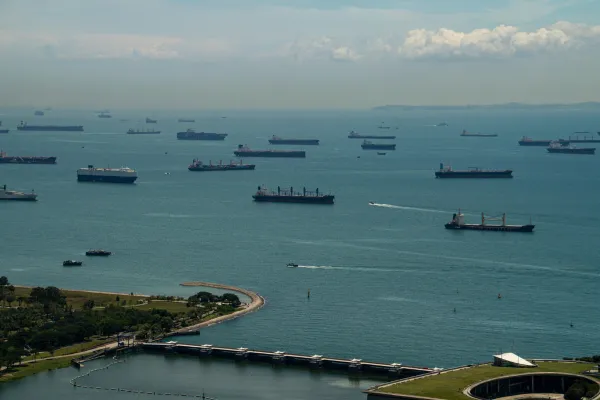
The Strait of Hormuz remains one of the world’s critical energy chokepoints. Reuters reports that the waterway normally handles about 20% of global oil and liquefied natural gas flows. When traffic through that corridor is severely disrupted, there is no easy replacement route that can absorb the loss quickly. The news agency’s March 15th analysis says that attacks on Gulf ports, refineries and shipping routes have already reduced Middle East output by an estimated 7 million to 10 million barrels a day, and repairs at some facilities could take weeks or months.
The location’s critical importance continues to evolve. Reuters reports that Iraq is now in talks with Iran to safeguard tanker traffic through Hormuz while also trying to revive the long-idled Kirkuk-Ceyhan pipeline to Turkey as a workaround. That pipeline once accounted for about 0.5% of global oil supply, according to Reuters, and Iraq said it could initially move 250,000 barrels a day, rising to 450,000 barrels a day if Kurdish flows are added. That is not enough to replace the lost Gulf traffic, but it is enough to show that exporters are moving from waiting for normalcy to actively searching for alternative routes.
Property owners do not need to predict geopolitics to learn the right lesson
A building owner in Denver, Dallas, Atlanta, Phoenix or New Jersey cannot control what happens in the Gulf. Policy response details matter less than what this kind of shock says about risk as energy security moves closer to home. In today’s volatile market, energy strategy now reaches into operating continuity, cost control, tenant retention and capital planning. If global events can push up fuel costs, disrupt logistics and expose fragility in centralized supply, then local flexibility becomes more valuable.
Local energy security does not mean every building needs to become an island. It means reducing unnecessary exposure and improving options. For one property, that may mean better load management to reduce peak costs. For another, it may mean adding battery storage to support key operations or smooth EV charging. For another, it may mean revisiting backup generation, fuel contracts or the role of on-site solar in reducing dependence on the most volatile purchased power. The point is not ideology, but usefulness. In a volatile market, these measures become practical tools for protecting operations and controlling costs.
Extending beyond commodities into resilience
Resilience is often framed as a storm or outage topic. The current crisis shows that resilience also includes price shocks, supply disruptions and continuity during broader market stress. A building does not need to lose electricity to be affected by an energy event. It can be affected through higher bills, tighter diesel supply, delayed deliveries or tenant concern about continuity and cost. That broader definition of resilience favors more layered planning. Owners who think only in terms of whether to power on or off may miss common forms of disruption. Owners who think in terms of exposure, substitution and flexibility are more likely to make decisions that still look sound after the headlines fade.
Bigger signals amid the noise
There is no reason for most owners to panic or make hasty capital decisions based on one crisis. At the same time, there is a strong reason to update how energy risk is viewed. Electricity, fuel and backup planning no longer belong at the edge of the strategy conversation. They sit closer to leasing, underwriting, capital planning and tenant service than they used to. That shift is already visible elsewhere in the market: power constraints are affecting site selection, storage is changing the value of solar and managed charging is changing the economics of EV deployment. The Middle East shock strengthens the same case from another direction. Global energy instability now travels faster and lands closer to the property line than many owners still assume. Local flexibility and lower exposure to volatile fuel flows are becoming more valuable business traits.
The owners most likely to come through that volatility well will not be the ones who can predict every geopolitical turn. They will be the ones who build properties and portfolios that can absorb shocks better: with smarter controls, better planning, more flexible power use and less exposure to the kinds of disruptions that begin far away but show up quickly in local costs and local risk.
Sources and further reading
