New York Pauses the Hyperscalers and Tells Them to Bring Their Own Power
By Keith Reynolds | Publisher & Editor, ChargedUp!
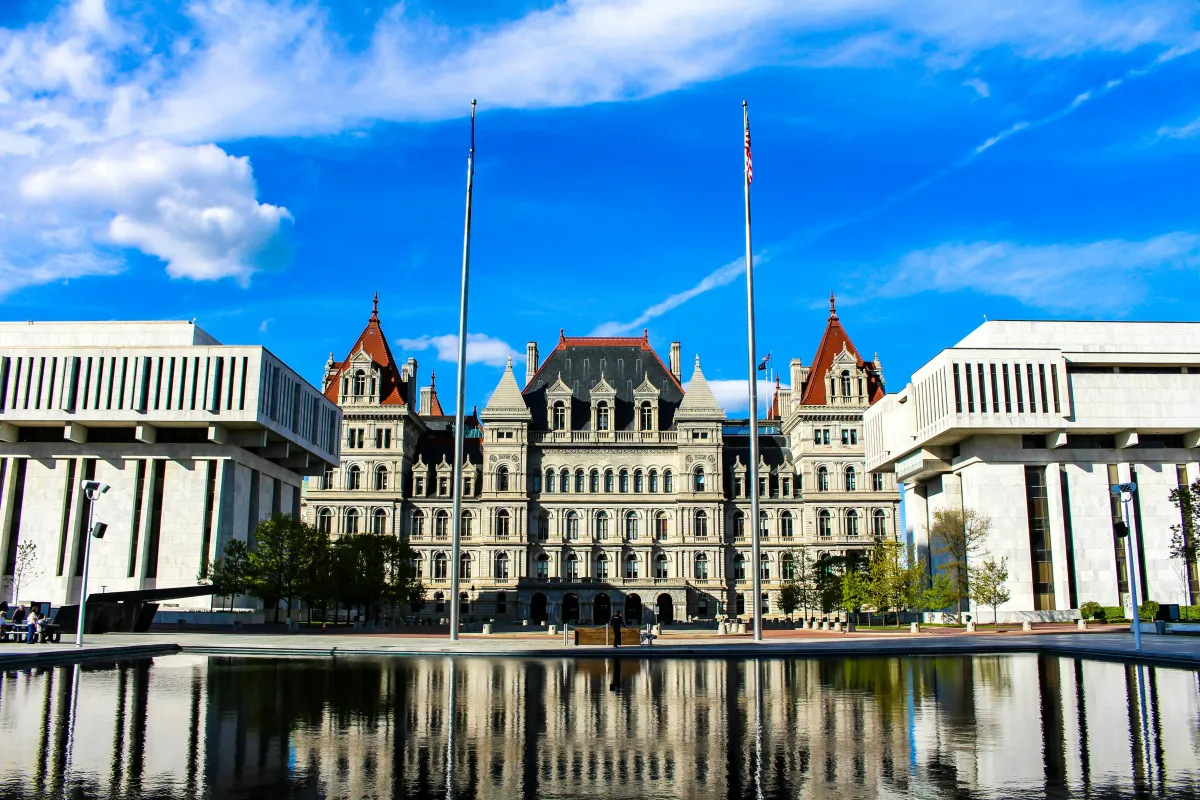
Governor Kathy Hochul signed an executive order Tuesday morning creating the first statewide moratorium on hyperscale data centers in the United States, pausing state discretionary permits for any facility drawing 50 megawatts or more for up to one year. Projects holding all required approvals proceed. Projects still waiting on a permit from the Department of Environmental Conservation stop, including a $19.4 billion campus in Genesee County that a Hochul staffer confirmed the order is expected to reach. Facilities serving hospitals, universities, and back-office financial operations fall outside the pause.
The moratorium will draw the headlines. The sentence that matters most sits further down the order. Hochul directed the Department of Public Service to consider approaches requiring data centers to fund new clean electric generation dedicated to their operations, naming customer-sited distributed energy resources and battery storage explicitly. No governor has previously written behind-the-meter generation into the price of admission for large load. New York just did, and the state is drafting the regulatory framework that turns that instruction into tariff language over the next twelve months.
The Order Reads Like a Term Sheet
Read the executive order as a set of conditions rather than a prohibition, and its architecture becomes clear. The Department of Environmental Conservation will produce a Generic Environmental Impact Statement establishing uniform benchmarks for energy demand, water use and quality, and air quality, which gives developers a single standard to design against instead of litigating each project separately. Within 60 days the state will issue guidance helping localities negotiate community benefits, naming infrastructure improvements, child care investment, and direct financial support as examples. Hochul said projects can include wage standards, labor agreements, and local hiring priorities, and confirmed that data centers will remain subject to local zoning and approvals.
The governor described the terms of release plainly. Companies will cover their power costs by bringing their own power or paying a premium to use the grid, and the state is exploring a fund that hyperscale operators would pay into to support the grid statewide. She also said she is pursuing legislation to repeal the sales tax exemptions data centers currently enjoy. The moratorium lifts once that policy framework exists, which the administration expects within the year. What the state is building is a standard offer: bring generation, pay for the grid you use, hire locally, and clear a defined environmental bar.
Four States, One Message, Ten Days
New York is the loudest instance of a pattern that hardened across four states inside of two weeks. Arizona Governor Katie Hobbs signed a three-year moratorium on new sales tax breaks for data centers following water and power backlash. North Carolina ended its electricity tax exemption for data centers while preserving incentives tied to capital investment. New Jersey Governor Mikie Sherrill signed legislation establishing dedicated data center tariffs alongside a cut to transmission owners' return on equity. Virginia's $0.011 per kilowatt-hour consumption tax took effect July 1.
Each measure separates the construction spending from the electrical load and treats them differently. States continue to welcome the capital investment, the jobs, and the tax base that a data center build produces. States have stopped subsidizing the megawatts that facility consumes once it opens. North Carolina drew that line with precision, keeping capital incentives while eliminating the power exemption. The political fuel is visible in the polling. A June Siena Research Institute survey found New Yorkers favored a one-year moratorium 46 percent to 21 percent, with Democrats backing it by 37 points and Republicans by 13. Electricity bills near major data center hubs have climbed as much as 267 percent over five years, and at least 11 states now carry active moratorium bills.
Distributed Generation Becomes an Entitlement Requirement
The New York directive completes a transition this publication has tracked for two years. Onsite generation began as an environmental preference, matured into a hedge against energy price volatility, and now becomes a condition of permit approval. A hyperscale developer in New York will need to arrive at the Department of Public Service with a generation plan attached to the load request, and customer-sited storage and distributed energy resources are the categories the state named. The interconnection queue stops being the only path to power. The site plan becomes the path to power.
That reframing travels well beyond the 50-megawatt threshold. Once a state regulator establishes that a large customer funds its own generation, the principle available to every subsequent rate case is that load pays for the capacity it creates. Owners of industrial, laboratory, cold storage, and mixed-use assets should read the New York framework as the template their utility will eventually apply at a lower threshold. The building that already generates and stores a portion of its own power has pre-complied with a rule that has not been written yet, and it holds an entitlement advantage its neighbors will have to buy.
The Valuation Line Runs Through the Permit
Scarcity value moves to whatever the state stops issuing. New York's order draws a bright line between assets holding a completed permit and assets that do not, and the line falls in the middle of active pipelines. A fully entitled, interconnected data center in New York gained value on Tuesday morning without a single physical improvement, because the supply of competing capacity froze for a year. The Genesee County project, at $19.4 billion, illustrates the reverse: investment scale offers no protection when permit status is the operative test.
The same logic prices every other property type. Net operating income compresses when delivered power costs rise, and the tariffs, taxes, and ratepayer protections spreading across these four states exist specifically to keep data center infrastructure costs from landing in the rates that offices, multifamily, retail, and industrial assets pay. Where those measures hold, they defend the utility expense line across an entire portfolio. Where they lag, the exposure shows up in the operating statement and then in the appraisal. Every $1,000 of annual energy cost avoided adds roughly $12,500 in asset value at an 8 percent capitalization rate, and the states now writing these rules are, in effect, adjudicating cap rates.
What to Do Before the Framework Lands
Three actions follow. Owners with New York projects in entitlement should determine immediately whether any outstanding Department of Environmental Conservation discretionary permit exists, because that single fact separates a project that proceeds from one that waits a year. Owners in the 11 states carrying moratorium bills should assume the New York framework becomes the drafting template and should model a generation requirement into any large-load pro forma now. And every owner outside those jurisdictions should recognize what the four-state pattern establishes: the era of the subsidized megawatt has closed, and the assets that appreciate from here are the ones already sitting behind a functioning interconnection with generation of their own.
