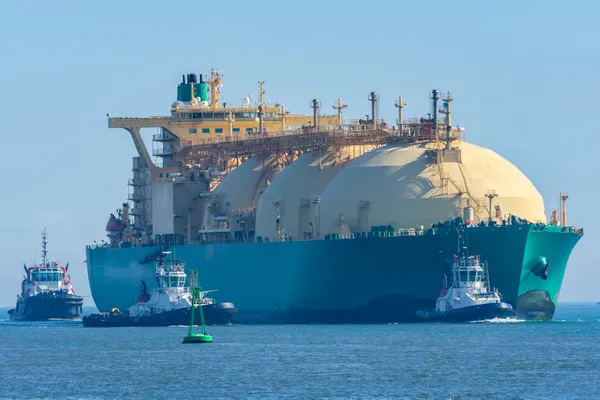
LNG: The Energy Shock Inside the Energy Shock
The Qatar Disruption Is Structurally Different From the Oil Story, with Direct Hits to Commercial Building Operating Budgets
By Keith Reynolds | Publisher & Editor, ChargedUp!
Brent crude above $114. WTI above $100 for the first time since 2022. The oil market has consumed six weeks of market coverage, policy attention, and executive bandwidth. It is real, consequential, and well-documented.
The more dangerous disruption for commercial real estate operating budgets is the one receiving a fraction of that attention: LNG.
On March 2, Iranian drone strikes halted LNG production at Ras Laffan Industrial City in Qatar, home to the world's largest liquefied natural gas export facility. On March 19, Iranian missiles struck Ras Laffan again, causing what QatarEnergy described as "extensive damage." The CEO of QatarEnergy, Saad al-Kaabi, confirmed that two of Qatar's 14 LNG processing trains and one of its two gas-to-liquids facilities were damaged. Repairs will sideline 12.8 million tonnes of LNG production per year for three to five years. The company has declared force majeure on some contracts, releasing it from delivery obligations due to circumstances beyond its control.
Qatar accounts for approximately 20 percent of global LNG exports. Its primary facility is now partially offline with a repair timeline measured in years, not weeks. All remaining exports are trapped behind a closed strait. And unlike crude oil, LNG has no viable rerouting option.
Why LNG Is Different From Oil
When oil tankers cannot use Hormuz, some reroute around the Cape of Good Hope, an option that adds significant additional cost and weeks of added transit time, but still a viable one. The Saudi East-West pipeline and the UAE's Fujairah pipeline offer partial land-based alternatives that bypass the strait for a portion of crude.
LNG has no equivalent workaround. The gas must be liquefied at dedicated facilities, loaded onto specialized tankers, and delivered to regasification terminals at destination ports. The entire chain is fixed infrastructure designed around specific supply routes. When Ras Laffan goes offline and the strait closes simultaneously, Qatari LNG simply does not arrive. There is no Cape of Good Hope equivalent for natural gas.
Europe normally sources 12 to 14 percent of its LNG from Qatar through Hormuz. Asian markets (China, Japan, South Korea, India) source the majority of their LNG from the region. Pakistan has closed schools and shifted to a four-day government work week to conserve energy. Bangladesh, where gas-fired generation accounts for half of electricity supply, is implementing widespread rationing. Eleven tankers originally bound for Europe have rerouted to Asia to capture spot market premiums, tightening European supply further.
Wood Mackenzie described the Ras Laffan attacks as "fundamentally" altering the global natural gas market outlook. ICIS projected that a three-month disruption would drive European natural gas benchmark prices 165 percent above pre-war levels, to approximately €85 per megawatt-hour. UK gas prices rose 50 percent in a single day after the initial March 2 attack - the largest one-day increase since Russia's invasion of Ukraine in 2022.
The Transmission Path to U.S. Commercial Properties
The mechanism by which a Qatari LNG disruption reaches a Chicago office building's utility bill or a New Jersey warehouse's generator fuel costs is not direct — but it is real, and it operates through several channels simultaneously.
Natural gas prices in the United States are less directly exposed to the Qatari disruption than European or Asian markets. The U.S. is the world's largest LNG exporter and has a large domestic gas production base, but is not insulated. In fact, as U.S. export capacity has expanded through 2026, the 'Henry Hub' price, the primary benchmark for US natural gas for pipeline-quality gas at a major hub in Erath, Louisiana, has become more sensitive to global events than it was in the previous decade.
The correlation between domestic costs and international disruptions has tightened significantly; when European buyers compete for U.S. LNG exports to replace Qatari supply, Henry Hub pricing reflects increased export demand. The natural gas futures curve in the U.S. has already moved higher in response to the global tightening.
The more direct transmission path is through electricity rates. In PJM's 13-state footprint, covering New Jersey, Pennsylvania, Maryland, Virginia, Ohio, Illinois, and eight other states serving 67 million people, natural gas-fired generation sets the marginal electricity price a significant portion of the time. When natural gas costs rise, wholesale electricity prices rise, and those wholesale prices flow into commercial utility bills.
The EIA reported in December 2025 that commercial electricity rates had already risen 7.8 percent year-over-year before the Iran war began. Natural gas and LNG disruption adds pressure to a rate environment already running above inflation.
For properties with diesel-dependent backup generation, such as data centers, medical office buildings, large multifamily properties, industrial facilities, the second channel is direct. Diesel prices in the U.S. are up 25 percent since the war began. Running and testing backup generators costs more. Backup systems sized for occasional 4-hour events may face sustained multi-day runs at costs their operators have not budgeted.
The Repair Timeline Changes the Medium-Term Calculus
The oil shock, severe as it is, resolves in principle when Hormuz reopens. Tankers resume transit, production flows back to market, and prices normalize over weeks to months.
Ras Laffan is different. QatarEnergy's CEO stated clearly that repairs will require three to five years. Qatar had planned to add six additional LNG trains by 2027, a development that European and Asian gas importers had incorporated into their long-term energy security planning. That expansion is now facing indefinite delay.
The $25 billion in infrastructure damage to Middle Eastern energy facilities represents not a short-term supply disruption but a medium-term reduction in regional production capacity. Even after Hormuz reopens, global LNG markets will operate with a structural supply deficit relative to pre-war projections for several years.
For commercial building owners managing energy budgets over 5- to 10-year hold periods, the medium-term LNG supply picture is as material to financial planning as the near-term oil price. Properties with long-term fixed-rate energy supply agreements, onsite generation hedging a portion of grid consumption, or battery storage enabling peak shaving and demand charge management have a meaningful structural advantage over fully grid-dependent properties.
What Owners and Operators Should Be Doing Now
The LNG disruption is not a force majeure that excuses inaction. It is a structural condition with a multi-year timeline that changes the economics of several decisions that were already in progress.
Energy procurement contracts up for renewal in 2026 or 2027 should be evaluated against a rate environment that is materially different from the assumptions used in prior contract cycles. Fixed-rate structures that once looked expensive relative to market may now represent meaningful hedges.
Backup generator fuel supply chains, along with associated contracts, the suppliers, the delivery frequency, the onsite storage capacity, should be reviewed against a diesel price environment that is elevated and may remain so. Properties that previously assumed standard diesel availability and pricing for their backup systems should stress-test those assumptions against current market conditions.
The longer-term design question - which buildings have the electrical infrastructure to add onsite solar, battery storage, and managed load capabilities, is now an urgent planning consideration. The energy transition from passive grid consumer to active distributed energy participant is the durable structural response to a supply environment that will not fully normalize for years.
The oil story gets the headlines. The LNG story gets the utility bills.
Sources and Further Reading
Al Jazeera: Gas prices soar as QatarEnergy halts LNG production
Al Jazeera: QatarEnergy declares force majeure on LNG contracts
CNBC: Iran missile attack on Qatar causes extensive damage to Ras Laffan
CNN Business: What strikes on the world's largest natural gas sites could do to the global economy
Middle East Eye: Ras Laffan — How Qatar gas hub attack is hitting Asia and beyond
