Storage Posts Its Largest Quarter Ever While Solar Stalls, and the Two Assets Separate
By Keith Reynolds | Publisher & Editor, ChargedUp!
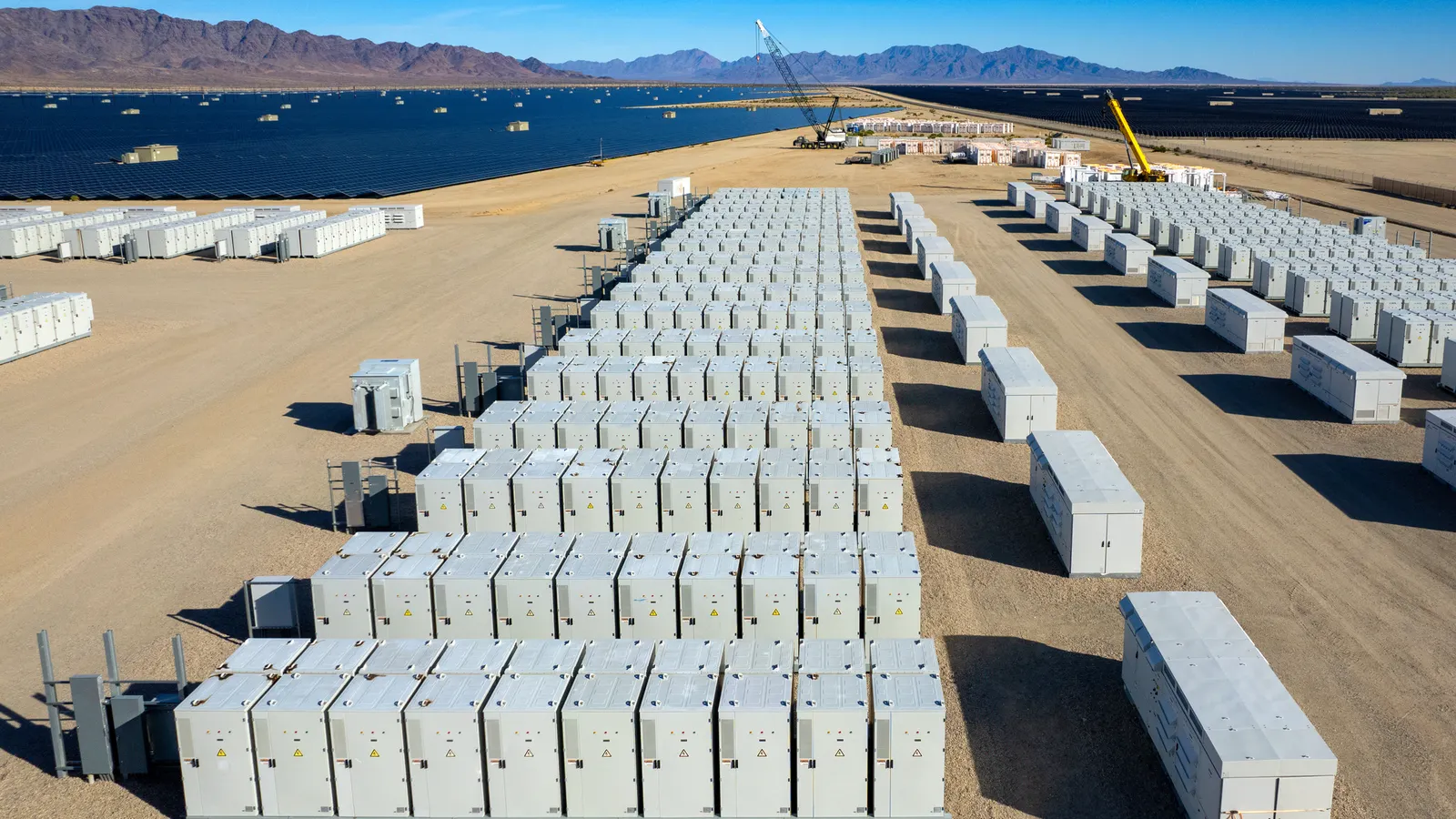
The United States installed 9.7 gigawatt-hours of battery energy storage in the first quarter of 2026, the largest opening quarter on record and a 32 percent increase over the year prior, according to the Solar Energy Industries Association (SEIA) and Benchmark Mineral Intelligence. Wood Mackenzie and the American Clean Power Association (ACP) count the same period at 3.3 gigawatts and 8.4 gigawatt-hours, a 54 percent jump in power terms. Solar and storage together supplied 91 percent of all new nameplate generating capacity added to the American grid in those three months.
The number to hold, though, is 673 megawatts. That is the record volume of battery storage homeowners installed in the first quarter per U.S. Energy Information Administration (EIA) data, achieved in a market where the federal residential solar credit has expired and rooftop solar installations have stalled. Batteries are growing while the generation they were designed to complement shrinks. The two assets have begun to separate, and the reason they separate explains where commercial energy capital should go next.
Tax Policy Split the Pair
The One Big Beautiful Bill Act preserved the investment tax credit for qualifying energy storage systems while accelerating the expiration of the corresponding credits for wind and solar. Storage kept a benefit that offsets 30 percent or more of deployment cost. Wind and solar lost the four-year construction runway on July 4th of this year. Congress created a divergence in project economics, and the deployment data arrived within two quarters showing exactly what that divergence purchased.
The behavior underneath the numbers matters as much as the totals. Developers spent the second half of 2025 safe-harboring project pipelines ahead of the rule changes, deferring operation dates into 2026, which inflated the first quarter figures. Foreign Entity of Concern restrictions are now in force and will shape equipment sourcing and inventory strategy for the next two to four years. Developers who locked supply agreements with battery manufacturers early hold an advantage; those who did not face consolidation or dependence on Chinese original equipment manufacturers. Supply chain qualification has become a diligence item on every storage proposal, and it belongs in the pro forma alongside the equipment quote.
Storage Now Earns on Speed, Not Just Arbitrage
The commercial, community, and industrial storage segment is forecast to grow 26 percent through 2031, with utility-scale capturing 85 percent of additions as large-load customers sign colocation and capacity contracts with storage providers. That sentence describes a market being sized off data center adjacency rather than solar attachment. BloombergNEF has tracked 4.9 gigawatts of announced storage co-located with onsite fossil generation at data centers, roughly 32 percent of announced global onsite battery capacity, where batteries fill the ramping gaps gas turbines cannot cover and protect those turbines from damaging cycling.
The value proposition has widened accordingly. A battery still arbitrages the daily price spread and shaves the demand charge, which typically runs $8 to $15 per kilowatt with a single 15-minute spike setting the entire month. A battery now also buys interconnection speed, because a load that arrives with storage attached presents a flatter, more controllable profile to the utility and clears a shorter study. In a market where connection waits run four to seven years, that acceleration carries more value than the arbitrage does. Bank of America Securities describes the operative sequence for large loads in 2026 as securing power quickly, firming it with storage, then layering solar as the lowest-cost marginal energy. Storage moved to the center of that stack.
Aggregation Turns Small Batteries Into a Capacity Resource
A new virtual power plant program will discharge power from distributed small batteries during events like the early July heat wave that drove PJM Interconnection demand to near-record levels. Eversource is separately running load management pilots in Massachusetts targeting specific substations with high solar penetration or summer-peak congestion. Both programs treat behind-the-meter storage as dispatchable capacity the grid can call, which converts an owner's asset into a revenue line during precisely the hours the system is most stressed.
Circuit-level targeting carries a consequence worth planning around. The value of a flexible building increasingly depends on which substation it sits behind, not merely which state or utility territory. Massachusetts already encodes this in the distribution circuit multiplier within its Clean Peak Energy Standard, which pays more for resources sited on load-constrained circuits. Owners evaluating a storage investment should ask the utility where their feeder ranks before sizing the system, because the same battery earns materially different revenue on two circuits a mile apart.
How the Capital Decision Changes
The practical guidance reverses a decade of habit. Storage no longer needs solar to justify itself, and treating it as an accessory to a photovoltaic array understates its return. Independent storage now earns from four distinct sources: avoided energy cost, demand charge reduction, capacity and demand response payments, and the interconnection speed it unlocks. The first two are bankable and grow with retail rates. The third and fourth depend on program design and utility posture, which makes them upside rather than foundation.
With commercial rates rising 4.8 percent year over year nationally and far faster in the District of Columbia, Ohio, and Maryland, the bankable base of that stack strengthens on its own. An owner who installs storage this year retains a federal credit that wind and solar projects can no longer claim, hedges a rate environment that keeps climbing, and holds an asset that state regulators are beginning to name explicitly in the conditions they set for large loads. Few energy investments align that many tailwinds in a single quarter.
