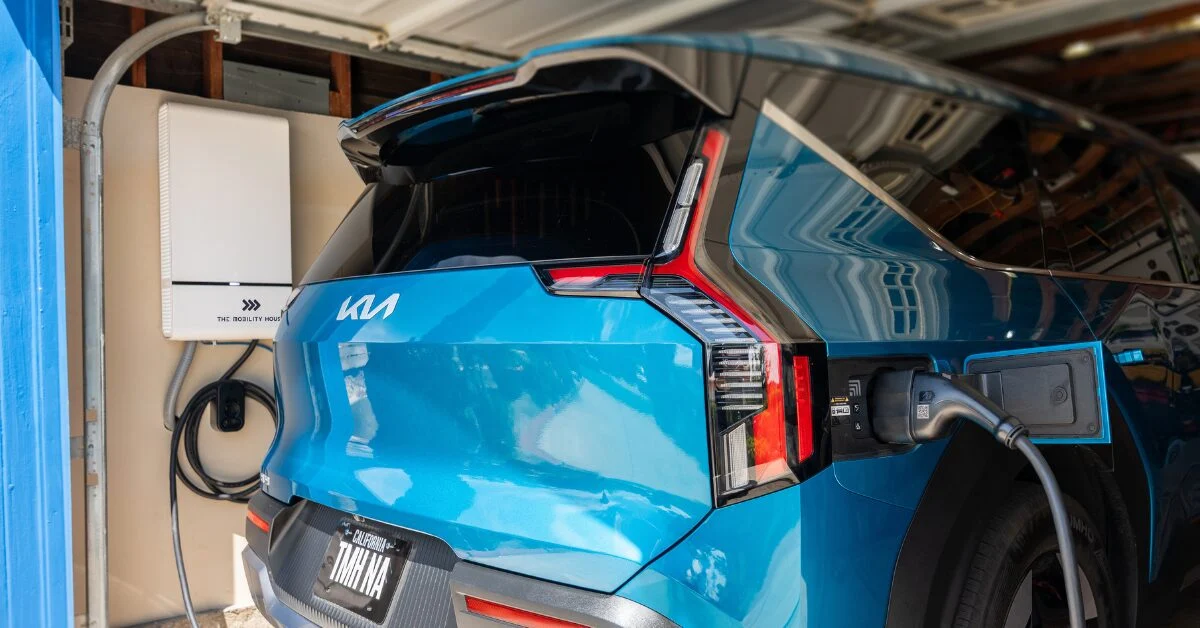
Your Parked Electric Fleet Could Earn Money. A New Program Shows Exactly How.
A group of utilities and technology companies just launched a program in Massachusetts that pays electric-vehicle owners to send power back to the grid from their parked cars during the hours the grid is strained. It builds on an existing network that already pays homeowners between $1,000 and $4,000 a year for similar flexibility. For a property with an electric fleet or charging for tenants, the message is that charging infrastructure is turning into a two-way asset: a car or a building battery can now earn income, not just consume power.
By Keith Reynolds | Publisher & Editor, ChargedUp!
What Was Announced
On July 23, five companies, the utilities Eversource and National Grid together with the technology firms EnergyHub, Sunrun, and The Mobility House, announced a joint effort to test vehicle-to-grid power in Massachusetts, letting qualifying customers enroll their electric vehicles in an existing program called ConnectedSolutions. Vehicle-to-grid, often shortened to V2G, means a car's battery can send power back to the grid, not just pull power from it. During periods of high demand, an enrolled vehicle discharges some of its stored energy to help relieve strain, and the driver is paid for the capacity provided.
The idea rests on a simple observation. A parked electric vehicle is a large battery sitting idle most of the day. Massachusetts alone has more than 150,000 electric vehicles on the road, and their batteries hold far more energy than a typical home battery, which makes a fleet of them a substantial power reserve. Coordinated by software, thousands of parked cars can act together like a power plant that switches on exactly when the grid needs it.
The Network Behind It Is Already Large
This is more than a science experiment bolted onto a small pilot. The ConnectedSolutions program it plugs into already operates across five states, coordinating more than 280,000 enrolled energy devices and over 800 megawatts of flexible capacity, drawn from thermostats, home batteries, and commercial and industrial equipment. The technology company coordinating the dispatch, EnergyHub, says its platform already manages more than 3.5 gigawatts of flexible capacity for over 240 utilities. In other words, the plumbing to pool many small energy resources and call on them together is built and running. Electric vehicles are simply the newest and largest resource being added to it.
The pooled resource has a name worth knowing: a virtual power plant. Rather than one physical plant, it is thousands of distributed batteries and flexible devices coordinated to behave like one. The concept traces back decades. Willett Kempton, a professor at the University of Delaware, is credited as a co-inventor of the underlying vehicle-to-grid technology, and the idea is already in commercial use in parts of Europe. What is new is the scale at which U.S. utilities are now willing to deploy it.
Implications for Properties
The commercial angle is where this gets concrete for an owner. Two paths open up.
The first is fleets. National Grid is already using vehicle-to-grid for light and medium-duty fleets within ConnectedSolutions, beginning with school buses, and Eversource is in talks with school districts through a version of the program that pays extra in grid-constrained areas. School buses are the ideal starting case because they sit parked and predictable all summer, and comparable state programs have shown school buses earning around $12,000 per summer and light vehicles around $3,000 by feeding power back to the grid. Any property with a predictable electric fleet—a logistics depot, a corporate campus, a municipal yard—is looking at the same opportunity: turning parked vehicles into a paid grid resource.
The second path is the building itself. The same program pays for flexibility from stationary batteries and from commercial and industrial equipment, not just vehicles. A building with a battery can earn the same kind of payments that New England homeowners already collect, the ones running between $1,000 and $4,000 a year, scaled up to commercial size. Charging infrastructure and storage stop being pure costs and become assets with a revenue line, which changes the math on whether to install them.
Why Utilities Are Suddenly Eager
It helps to understand why utilities are paying customers for this. The grid is strained, as the emergency measures at regional operators this summer make clear, and building new power plants and transmission is slow and expensive. Paying thousands of existing batteries and vehicles to discharge during the few hundred hours a year when demand peaks is far cheaper than building a new plant that sits idle the rest of the time. A virtual power plant lets a utility rent flexibility instead of building capacity, and the customer collects the rent.
The people running these programs describe them in exactly those terms. An Eversource executive called ConnectedSolutions a nation-leading model for virtual power plants, and the president of EnergyHub called it the gold standard for how utilities can scale them. For an owner, the useful translation is that utilities now have a real budget to pay for flexibility, and that budget is a revenue opportunity for any property that can provide it.'
The Honest Caveats
A few cautions keep this grounded. The Massachusetts effort is a test, framed by its own participants as a way to gather real-world data before scaling, so the vehicle-to-grid piece is early. Vehicle-to-grid also requires a bidirectional charger and a compatible vehicle, which adds equipment cost, and frequent discharging raises questions about battery wear that the pilots are studying. Payments and program rules vary by utility and state, so the numbers that apply in Massachusetts will not map exactly onto another market. This is an opportunity to track and pilot, not yet a guaranteed income stream everywhere.
Owners’ First Steps
For a property owner intrigued by this program, the sensible path forward is to start where the economics already work and treat vehicle-to-grid as the emerging layer on top. The proven money today is in stationary batteries and load flexibility. A commercial battery installed for backup and demand-charge savings can enroll in programs like ConnectedSolutions and earn demand-response payments now, in the same five states and others, without waiting for the vehicle piece to mature. That is the foundation, and it pays for itself on established terms.
The vehicle layer comes next, and fleets lead. An owner with a predictable electric fleet, whether a delivery operation, a municipal yard, or a campus shuttle, should ask the local utility what fleet vehicle-to-grid or demand-response programs exist and what they pay, and should specify bidirectional-capable chargers and vehicles when replacing equipment, so the option is available when the programs scale. The cost premium for bidirectional capability is falling, and building it in now is cheaper than retrofitting later. For properties charging tenants or the public, the same logic applies more gradually, as bidirectional vehicles grow as a share of the fleet on the road. The point is to build the capability into today's decisions rather than to bet the business on a program still being tested.
The Bottom Line
The direction, though, is unmistakable and consistent with everything this series has argued. For a century, power flowed one way, from the utility to the building, and the building paid. Programs like this one make the building and its vehicles into suppliers that get paid, turning parked cars and idle batteries into income. A property that installs charging and storage today is no longer just buying a cost or an amenity. It is buying an asset that can lower its bills, back up its operations, and increasingly earn revenue by helping a strained grid through its worst hours. In a market where power is scarce and getting scarcer, owning the flexibility that utilities now compete to rent is one more way a building protects its income and its value.
