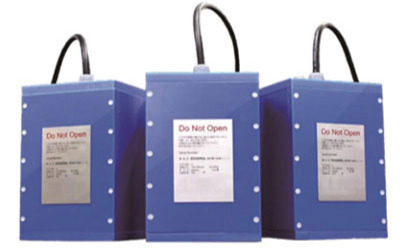
The $144,000 Question: Why a Japanese Energy Efficiency Device Is Finding Traction in America's Power-Hungry Facilities
Yuasa International's Ecomo delivers up to 15% electricity bill reduction at a moment when grid constraints and rising rates are forcing a new conversation about operational waste. This transformer-level add-on device is for sites spending $75,000+ monthly on electricity and has a ROI payback in typically 3-5 years.
By Keith Reynolds | Publisher & Editor, ChargedUp!
The cheapest energy a company can ever acquire isn't found in a new solar farm or a deregulated utility contract. It's the electron you save.
That's more than marketing poetry. It's the increasingly practical economics for facility operators watching their monthly power bills climb while the grid gets harder to access, slower to expand, and more expensive to tap.
For organizations spending $75,000 to $100,000 or more each month on electricity, even conservative reductions in waste can free up meaningful cash flow. At an $80,000 monthly bill, a guaranteed 5% reduction delivers $48,000 annually. At 10%, that figure doubles to $96,000. At 15%, annual savings reach $144,000.
While numbers like these may seem out of reach, Japanese manufacturing firm Yuasa International has developed a product to help facilities achieve these targets. ChargedUp! recently spoke with Yuasa sales managers Kenichi Kato and Max DeCapri about the Ecomo energy efficiency device the company is bringing into the U.S. market.
Yuasa is positioning the Ecomo as a targeted solution for facilities that understand waste is expensive and are tired of being told efficiency requires a multi-year capital project. The pitch is straightforward: The Ecomo is a transformer-level efficiency unit designed to reduce electricity consumption by up to 15%, with a 5% minimum savings guarantee. It installs in under an hour, requires no maintenance, and targets the electrical loss that occurs naturally between a facility's transformer and its load that consumes the energy. DeCapri explains how the platform addresses facilities' increasing energy costs:
A Market That Suddenly Feels Tighter
U.S. power demand is rising after years of relative stagnation, driven by data centers, industrial activity, electrification, EVs, and energy-intensive digital infrastructure. The International Energy Agency reports that U.S. electricity demand rose 2.1% in 2025 and projects nearly 2% annual growth through 2030, with roughly half driven by data centers. Lawrence Berkeley National Laboratory estimates that data centers consumed about 4.4% of total U.S. electricity in 2023 and could account for 7% to 12% by 2028.
Meanwhile, Berkeley Lab's latest interconnection analysis found that as of late 2024, about 10,300 projects representing 1,400 gigawatts of generation and 890 gigawatts of storage were still waiting to connect to the grid. In a recent ChargedUp! exclusive interview, Haroon Inam, noted that the interconnect backlog was 23 hundred gigawatts.That's enough electricity to power 23 cities roughly the size of Jacksonville FL or Denver CO.
Furthermore, the median time from interconnection request to commercial operation has more than doubled, from under two years for projects built between 2000 and 2007, to over four years for those completed between 2018 and 2024.
The Energy Information Administration reported that the national average electricity revenue per kilowatt-hour in December 2025 was up 7.1% year-over-year. Commercial prices rose 7.8%, and industrial prices climbed 7.2%.
If new power is harder to secure and more expensive, then getting more from the power already flowing through a facility starts to look less like a technical footnote and more like a strategic business decision.
Why Japan's Experience Matters Now
Part of Ecomo's story is rooted in Japan's acute awareness of energy security and the cost of waste. The 2011 Fukushima disaster sharpened that national focus dramatically, forcing Japan into planned power outages and creating urgent demand for efficiency solutions.
Kato, who leads pricing and agreements for the company, identifies a direct line between that crisis and Ecomo's rise.
The U.S. is beginning to encounter similar pressures: tighter supply, higher demand, more scrutiny on emissions, and a greater premium on practical efficiency.
As a net importer, Japan has grappled with energy constraints for many years, a challenge currently confronting the United States. The Fukushima nuclear reactor accident in 2011 exacerbated their energy system’s vulnerabilities. Already attuned to efficiency measures, there was a renewed national initiative to conserve energy that the Ecomo addressed. It’s now installed throughout Japan at high-consumption locations. The technology, with its proven track record, today presents an immediate solution to disruptions the U.S. now faces.
The Business Pitch
Yuasa is careful about how it describes Ecomo. The company doesn't want the conversation stuck in an engineering debate, especially because the product incorporates proprietary, patented technology. What they will say is that Ecomo targets avoidable electrical loss between the transformer and the load.
DeCapri, who joined Yuasa International after studying renewable energy in Japan, explained the technology clearly:
The Ecomo uses the natural minerals tourmaline and ferrite to improve electrical flow and reduce noise. Tourmaline generates free electrons that reduce resistance in wiring. Ferrite absorbs electrical noise from transformers. By installing Ecomo on the secondary side of a transformer, the unit addresses loss at the source.
The more compelling part of the pitch may be what the Ecomo doesn't require:
No major retrofit
No scheduled maintenance: There are no internal electronics or capacitors that degrade.
Installation in 30 minutes to an hour: A certified electrician simply crimps the Ecomo onto the transformer's busbar and setup us complete
For organizations with limited appetite for operational disruption, that matters as much as the savings claim. It reframes the question from "Should we undertake a major energy retrofit?" to "Should we test a targeted efficiency measure that can be validated?"
The Economics That Matter
Kato emphasized that the Ecomo's core value proposition is about operating cost reduction and profit improvement.
Ecomo's economics become compelling for a facility spending $75,000 a month or more on electricity. At that level, even a conservative 5% reduction becomes worth executive time. The annualized savings are visible, the payback case can be modeled, and the outcome is easier to compare against other uses of capital.
Yuasa's process begins with data gathering: monthly usage, billing history, installation points, and operating profiles. From there, the company develops a savings simulation and ROI estimate, generally using a 7% baseline while presenting the broader 5% to 15% range.
DeCapri said Yuasa's strongest differentiation for skeptical buyers is that result verification is discussed before installation, not after. Depending on the equipment and operating conditions, savings can be measured per operating hour, per unit produced, or per machine cycle, then compared against the customer's own historical baseline.
That's a smart answer to the most common objection: Prove it.
Four Paths to the Same Answer
What makes Ecomo's performance data particularly credible is not uniformity, but adaptability. Yuasa has verified savings across four very different industrial applications - frozen food production, automotive parts stamping, drivetrain assembly, and automation components manufacturing, using measurement methods tailored to how each facility actually operates.
The frozen food producer tracked electricity consumption against production volume across three output ranges. The baseline method: kilowatt-hours per unit produced. At the low end of production (70,000 to 79,999 units), ecomo delivered a 13.4% reduction in energy per unit. At mid-range output (80,000 to 89,999 units), savings dropped to 7.1%. At the high end (90,000 to 99,999 units), the reduction was 9.5%. Overall: 10% savings.
The automotive parts manufacturer took a different approach. With four press machines cycling constantly, Yuasa measured watt-hours per press shot. Across different machine processes, savings ranged from 2.2% to 10.9%, with an overall verified reduction of 6.6%. The key insight: energy intensity per shot declined consistently, even as production tempo varied.
The drivetrain facility in Mexico used both production volume and operating hours as verification metrics. Power consumption per unit produced dropped 6.4%. That data point mattered because the facility had precise production counts and a stable baseline period spanning more than two years. The company excluded one outlier month (July 2023, which showed unusually high consumption) and built the comparison around statistically valid correlation (R² value of 0.9053). The result: a clean, defensible savings claim backed by the customer's own operational data.
The automation components manufacturer measured performance across three distinct product lines, each with different cycle times and energy profiles. Item A showed a 5.9% reduction in energy per unit. Item B, measured across four production scenarios, averaged 4.4% savings. Item C, tracked across three configurations, delivered 5.9% savings. Across all three product lines: 6.87% overall reduction in energy intensity per unit produced.
What ties these cases together isn't a single verification protocol. It's the flexibility to meet each customer where their data actually lives. Some facilities have granular machine-cycle data. Others track monthly production totals and operating days. Yuasa adapts the measurement approach to the available baseline, runs the correlation analysis to confirm statistical validity, and only then commits to a verification method.
For executives evaluating Ecomo, that process discipline matters. The 5% guarantee isn't speculative. It's conservative. And the actual savings, 6% to 10% across verified installations, suggest the technology performs consistently across wildly different operating environments, provided the measurement method is sound.
The takeaway for a U.S. facility manager or CFO is straightforward: if you have a year of billing data, a known transformer load, and a way to normalize energy use against output or operating time, Yuasa can model whether ecomo makes economic sense for your site. If the numbers work, the company will verify results using your data, your metrics, and your timeline, not theirs.
DeCapri said the Ecomo’s strongest fit is with high-energy users where power consumption is both substantial and operationally intensive, including spikes from lots of on-off activity. That is where the largest savings occur.
Yuasa has installations in supermarkets, manufacturing facilities, hotels, hospitals, and care facilities. The economic case becomes most compelling for organizations with large, consistent electrical loads and meaningful annual utility spend.
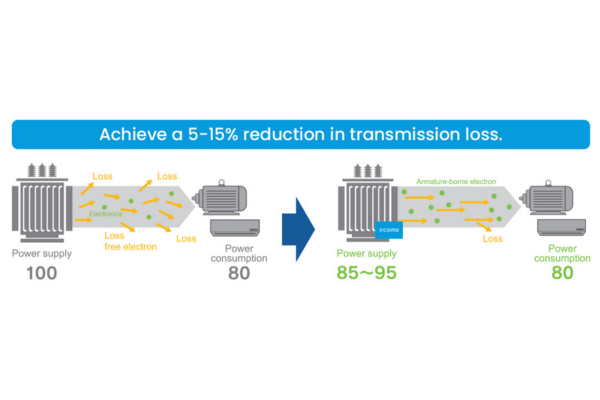
For companies with ESG mandates, the Ecomo offers a secondary benefit: reducing electricity consumption directly reduces Scope 2 emissions. Yuasa's simulation tool includes CO₂ emission reductions as part of its ROI modeling. But for most executives evaluating Ecomo, carbon is the value-add. Cash flow is the decision driver.
The Larger Lesson
For the last decade, the energy transition has often been sold through large-scale initiatives: solar, storage, microgrids, EV infrastructure. While those efforts are real and important, many executives are still left with a more immediate question:
What can we do now, inside the footprint we already operate, with limited friction and a clear return?
That's the lane Yuasa International is trying to occupy with Ecomo. The company isn't arguing that efficiency alone will solve America's power challenges. It's arguing something more modest, and perhaps more persuasive: in an era of rising electric demand, slow interconnection timelines, and upward pressure on rates, waste inside existing buildings and facilities starts to look less like a technical nuisance and more like an avoidable business cost with a little capital planning.
If that's true, then facilities with very large monthly power bills should at least take the meeting.
Because the cheapest power in the market may still be the power a business never has to buy in the first place.
See the Ecomo Up Close at NPC 2026
Yuasa International will be showcasing Ecomo at the American Planning Association's 2026 National Planning Conference in Detroit this April, within the ChargedUp! Pavilion. For more information or to request a savings simulation, visit yuasa-intl.com/ecomo or contact Yuasa International's Cincinnati office at (847) 440-6563.
Join ChargedUp! at The American Planning Association National Planning Conference 2026
The ChargedUp! Pavilion at the American Planning Association’s National Planning Conference (NPC26) in Detroit this April 25-28 is where the tomorrow's technologies meet today's planners and policymakers. If you are an innovator in this space, don't miss this chance to position your product in front of the audience who will write your solutions into the legal requirements of our communities. Inquire about exhibitor, speaking and sponsorship opportunities today.
The Ecomo's Economic and Practical Impact
Guaranteed Savings: Yuasa International offers a 5% reduction guarantee; if the savings are lower after a 13-month verification, a full refund may be available*.
Proven Deployment: It has been installed in over 1,000 business locations globally, including chemical plants and automotive manufacturers.
Payback Period: The average return on investment (ROI) is estimated at 3 to 5 years.
Ecomo Key Features
Mineral-Based Technology: The Econo utilizes the piezoelectric properties of tourmaline to release electrons that supposedly "lubricate" the flow of electricity and reduce wire resistance.
Noise Reduction: The ferrite component is designed to absorb harmonic noise, stabilizing transformer operation.
Maintenance-Free: Because it contains no capacitors or IC chips, it has a long design life of 15 to 20 years and requires no external power source.
Simple Installation: The unit typically installs in 30 to 60 minutes by connecting it to by connecting it “behind the meter” to the secondary side of the transformer or switchgear.
*Terms and conditions are fully disclosed.
Sources and Further Reading
IEA Electricity 2026: https://www.iea.org/reports/electricity-2026/executive-summary
Berkeley Lab data center demand: https://newscenter.lbl.gov/2025/01/15/berkeley-lab-report-evaluates-increase-in-electricity-demand-from-data-centers/
Berkeley Lab interconnection queues: https://emp.lbl.gov/queues
EIA electricity update: https://www.eia.gov/electricity/monthly/update/end-use.php
EIA wholesale prices: https://www.eia.gov/todayinenergy/detail.php?id=67106
