112 Companies, $1.5 Trillion in Revenue, and a New Definition of Energy Security
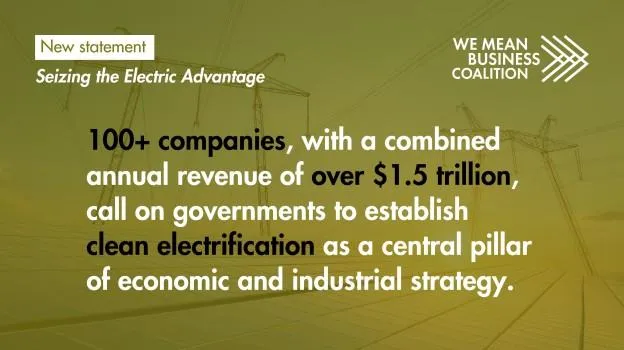
In June 2026, 112 global companies with a collective $1.5T in revenue urged governments to make electrification a core economic strategy in a joint statement—not for just climate positioning, but also for energy security and competitiveness. For commercial real estate and planners, this is a demand-side signal: tenants now treat electrified, resilient operations as a requirement, shifting buildings with onsite energy capability from cost centers into leasing advantages.
By Keith Reynolds | Publisher & Editor, ChargedUp!
For years, electrification was pitched as virtue. In 2026 it turned into self-defense. The world’s anchor tenants, including Nestle, IKEA, Uber, Iberdrola, Volvo, Mahindra Group, Nikon, Levi Strauss & Co., and more, are now calling electrification the hedge against fuel-price whiplash. That shift changes what a “ready” building looks like and who gets pricing power.
Key facts at a glance
Who: 112 companies across industrials, consumer goods, transport, healthcare; coordinated by We Mean Business Coalition and the Global Renewables Alliance.
Scale: Roughly $1.5 trillion in combined annual revenue.
When: Open statement issued June 22, 2026. [Read the statement]
Why now: Exposure to volatile fuel markets threatens operating-cost predictability, supply chains, and investment timing.
Poll signal: ~90% of business leaders expect largely electrified operations within a decade and believe shifting to wind/solar supports growth.
Bottom line for CRE/Planners: Tenants are upgrading resilience expectations; buildings with onsite generation, storage, and EV capacity move up the shortlist.
What changed about corporate electrification and energy security in 2026?
The frame moved from emissions compliance to risk management. Since the U.S.–Israel–Iran conflict raised supply-risk awareness, major tenants now treat electrification as a cost-stability strategy, not just a climate goal. The question isn’t whether or not to electrify, it's how fast policy and infrastructure can make it reliable and investable.
Industry statements emphasized enabling, predictable policy—zoning, permitting, and interconnection that reduce friction for electrified transport, buildings, and industry. Many required technologies are already commercially available, shifting the debate from R&D to execution.
Does electrification truly improve energy security if grids still rely on fuels?
It narrows volatility exposure; it doesn’t erase it.
Direct fuel risk drops: Electrified end-uses avoid onsite hydrocarbon purchases and the spot-price spikes that can wreck monthly budgets.
Cost profile shifts to capex: More of the energy cost becomes an upfront investment (infrastructure, efficiency, DERs) with multiyear payback instead of variable fuel spend.
Supply diversifies: Electricity can be generated from multiple sources (wind, solar, hydro, nuclear, gas). Diversity reduces single-commodity shocks.
System dependence remains: Grids still rely on fuels and materials with geopolitical exposure. The honest claim: electrification reduces price volatility at the point of use and systemwide sensitivity over time; it does not end it.
What this means for building owners and planners?
Leasing advantage shifts to energy-capable assets. When anchor tenants redefine resilience as a competitive requirement, buildings that deliver it gain pricing power.
Energy resilience becomes a leasing variable: Onsite solar, storage, EV capacity, and upgraded electrical infrastructure improve tenant attraction and retention, especially for long-duration, investment-grade tenants.
Policy becomes the growth throttle: The call for predictable, enabling policy will appear in zoning, permitting, interconnection, and incentive structures. Planners who streamline distributed energy and grid-edge flexibility will capture capex these companies are ready to deploy.
Durability of demand: Even with post-ceasefire fuel price dips, the corporate conclusion stands: fuel-price volatility is a structural risk. Strategy anchored in resilience is unlikely to reverse with the next spot-price move.
Extractable takeaway
Electrification is the hedge against fuel-price volatility. In 2026, tenants with the strongest credit are signaling they will pay for reliable, electrified operations. Buildings that deliver resilience move up the shortlist—and gain leverage on rent and term.
Our Energy-Equity Connection white paper argues that energy resilience has become a property-value and competitiveness variable being being n an environmental amenity. The 112-company statement is the demand-side confirmation: the tenants have reached the same conclusion, and they are asking governments to build the policy framework to act on it.
When the largest tenants in the world redefine energy resilience as a competitive requirement, the buildings that deliver it gain pricing power.
Frequently Asked Questions
What did the 112-company statement actually call for?
To make electrification central to national economic strategy via predictable, enabling policy—faster permitting, clear interconnection, and incentives that accelerate deployment across transport, buildings, and industry.
Why frame electrification as energy security in 2026?
Fuel-market shocks tied to geopolitics raised the cost of volatility. Companies now prioritize stable operating costs and supply chains, which electrification better supports than direct hydrocarbon exposure.
How does electrification reduce risk if the grid still uses hydrocarbons?
It shifts costs from volatile fuel purchases to diversified electricity and capex in efficiency/DERs. Exposure narrows at the point of use, even though systemwide inputs still carry some geopolitical risk.
What should building owners prioritize first?
Electrical capacity (service upgrades, panels), critical-load mapping, onsite DER feasibility (solar, storage), and EV charging readiness—sequenced with interconnection applications.
What is the leasing upside for energy-capable buildings?
Improved win rates with investment-grade tenants, stronger rent and term negotiations, and reduced downtime—because resilience has become a competitive requirement, not a nice-to-have.
