The Mideast Energy War, Part 14: Kuwait Strike Shatters Cease-Fire Trade; What It Means for CRE, Oil, and Distributed Energy
This is Part 14 of the ChargedUp! Mideast Energy War series. Previous entries are archived here. The series tracks the transmission mechanism from geopolitical shock through energy markets, Treasury yields, capital costs, and commercial real estate valuation, with implications for distributed energy investment decisions at the property level.
By Keith Reynolds | Publisher & Editor, ChargedUp!
Part 14: From 60-Day MOU to Kuwait in Flames
The cease-fire trade lasted less than a week. A strike on Kuwait has forced markets to reprice oil, inflation risk, and refinancing conditions just as commercial real estate owners face tighter incentive deadlines and a more fragile power economy.
By late morning in London last Friday, Brent crude was trading at $92.56 a barrel, down 1.2 percent on the day and nearly 19 percent for the month, the global benchmark's worst monthly performance since the COVID-19 pandemic. Markets were leaning into a simple story: the United States and Iran appeared close to a 60-day memorandum of understanding to extend the cease-fire that had been held since April. Bob Parker, senior advisor at the International Capital Markets Association, told CNBC that oil would likely sit between $90 and $100 for the next couple of months while a deal was finalized. Treasury yields had eased from their May 19 highs. Equity markets pushed records on technology and AI strength. For a moment, investors were pricing de-escalation.
By dawn this morning, that view looked far less secure.
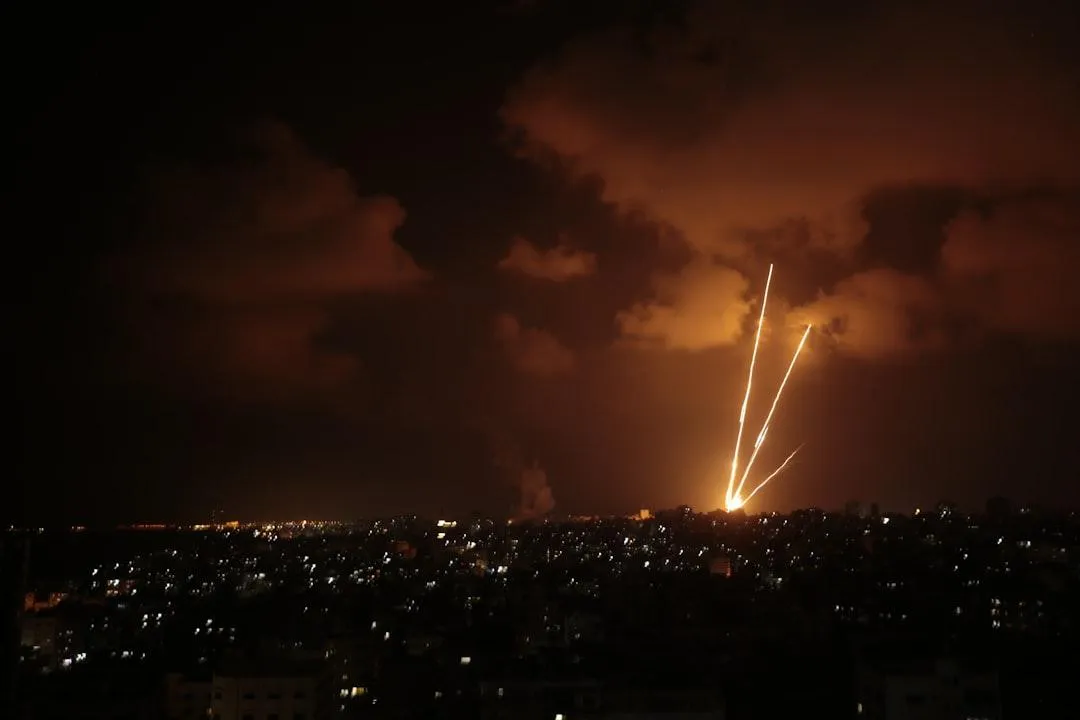
An Iranian drone and ballistic missile strike on Kuwait International Airport killed one civilian, wounded 63, and damaged Terminal 1 and the airport's radar system. Kuwait's General Directorate of Civil Aviation suspended commercial flights at the damaged terminal; Kuwait Airways resumed limited service through Terminal 4 later in the day after a safety review. The airport only reopened to international traffic two days earlier, on June 1, following months of disruption traced to the original February 28 outbreak of the war (Washington Post; Al Jazeera; Gulf News on Terminal 4 resumption).
U.S. Central Command said U.S. and Bahraini air defenses intercepted three Iranian missiles aimed at Bahrain. Two missiles aimed at Kuwait fell short. U.S. forces shot down three one-way attack drones targeting civilian shipping in the Gulf before conducting what CENTCOM described as self-defense strikes on Qeshm Island, the Iranian territory at the eastern mouth of the Strait of Hormuz. Iran's Islamic Revolutionary Guard Corps released a video claiming all predetermined targets had been destroyed and warned that any U.S. repeat would draw a "completely different" response (CNN live updates; The National).
Brent climbed toward $97 by mid-morning in London, the third consecutive session of gains. API data released ahead of the official EIA report showed a 6.75 million barrel drawdown in U.S. crude inventories, extending the consecutive weekly drawdown streak that began in mid-April (Trading Economics). The Hormuz Hangover thesis that anchored our Part 13 coverage last week just got considerably harder.
How the market tried to normalize and failed
The speed of the reversal matters.
This past Monday opened with Iranian state media reporting that Tehran had suspended indirect communications with Washington over the Lebanon fighting and was preparing to fully close the Strait of Hormuz. Oil spiked 8 percent intraday before paring gains to about 6 percent on the close, after Trump downplayed the suspension and said he did not care whether the talks were over. Israel and Hezbollah agreed to halt cross-border attacks, briefly easing one active escalation front. By Tuesday morning, oil was building a third consecutive session of gains as Iranian state media doubled down on the suspension narrative and Trump separately said an MOU to reopen Hormuz could be reached "within the next week" if Iran provided written commitments on nuclear concessions (Trading Economics archive). Then came the overnight attack on Kuwait.
Washington and Tehran offer competing accounts of who escalated first. The Iranian formulation treats U.S. operations near the Strait of Hormuz as the original provocation, including a claim that a U.S. projectile struck an Iranian oil tanker. The American formulation treats Iranian attacks on Gulf shipping and regional infrastructure as the original provocation. Both sides now have an internally coherent escalation story that does not require resolution. Markets do not wait for diplomatic consensus. They price supply risk, inflation risk, transport risk, and policy uncertainty in real time. The question for property owners, developers, lenders, and planners is not which framing is correct, but which framing the energy and financial markets will price.
Why this matters beyond a headline shock
The current supply situation extends the story’s relevance beyond a single news cycle. The May Short-Term Energy Outlook from the U.S. Energy Information Administration assessed that Iraq, Saudi Arabia, Kuwait, the UAE, Qatar, and Bahrain collectively shut in 10.5 million barrels per day of crude oil production in April. The EIA projected global oil inventories would fall by an average of 8.5 million barrels per day in the second quarter of 2026, keeping Brent prices around $106 a barrel in May and June. The agency models a fall to $89 in the fourth quarter and $79 in 2027, but only on the assumption that the Strait of Hormuz returns to normal commercial traffic before the end of May. Events this week make that assumption harder to defend.
UBS analysts led by Henri Patricot noted last week that there is "little evidence" of any short-term improvement in vessel traffic or energy flows through the region. Iran crude loadings for May were below 0.3 million barrels per day, down sharply from April's average of 1.5 million and March's 1.7 million. The June 9 EIA STEO update will reflect what the agency knows about June flows, and the timing relative to the Kuwait attack matters.
The Aramco quote that defined the supply story in May still defines it now. Saudi Aramco CEO Amin Nasser told investors on the company's first-quarter earnings call: "If the Strait of Hormuz opens today, it will still take months for the market to rebalance, and if its opening is delayed by a few more weeks, then normalization will last into 2027" (CNBC). When the chief executive of the world's largest oil producer makes a comment like that, the market structure has to be priced accordingly.
This is the core of the Hormuz Hangover thesis this series has been tracking: Even when headlines improve, the physical market may take longer to heal than financial markets first assume. This week did not create that problem; it reinforced it.
Treasury yields, cap rates, and the refinancing window
For ChargedUp! readers, the central issue is not crude itself - it is transmission.
When oil prices rise on renewed supply fears, inflation concerns tend to rise with them. That correlation matters for Treasury yields, for expectations around Federal Reserve policy, and ultimately for real estate financing. The 30-year Treasury yield peaked at 5.197 percent on May 19 and eased through the end of May as the cease-fire trade gathered momentum. The 10-year sat at 4.50 percent by May 26. Equity markets reached record highs on the same optimism. None of that was a durable retreat. With Brent climbing toward $97 and Iran reopening a hot front in Kuwait, the inflation pass-through that drove yields to their May peak remains the operative concern.
The June economic data calendar will determine the Federal Reserve's read. The May CPI release lands June 11. The Federal Open Market Committee meets June 16 and 17. Prediction markets entered this week, pricing roughly a 97 percent probability that the FOMC holds the federal funds rate at its current 3.50 percent to 3.75 percent range, per DeFi Rate aggregated odds from Kalshi and Polymarket. The same markets put 57 percent odds on zero cuts across all of 2026. The April 29 FOMC vote was 8-4 to hold, the most dissents on a single vote since October 1992. The practical question for property owners is not whether the June meeting produces a cut. It is whether the cumulative June data — CPI, the EIA outlook, and Mideast developments — gives the central bank room to ease later in the year.
For owners with debt maturing over the next 12 to 24 months, the practical implication is that windows can open and close quickly. A refinancing that looked workable when oil was falling, yields were easing, and risk appetite was firm can look much less attractive when energy prices rebound, and inflation expectations move up again. This is the Energy-Equity Connection in real time: geopolitical shock feeds energy prices; energy prices influence inflation expectations; inflation expectations shape Treasury yields; Treasury yields affect cap rates and borrowing costs; and those financing costs determine whether projects, acquisitions, and refinancings still pencil. The week of May 27 to June 3 ran that transmission mechanism in both directions.
The AI bid, the cost-discipline crosscurrent, and what it means for power demand
The equity market complicates the picture. Technology shares, especially around AI infrastructure, helped push indexes higher through May. Hyperscalers committed a combined capital expenditure of roughly $725 billion in 2026, per Financial Times reporting compiled from Q1 earnings, up 77 percent from 2025's record. The bull narrative remains intact while the build-out continues.
The crosscurrent emerging this week is the cost discipline story. Microsoft has begun canceling internal Claude Code licenses in its Experiences and Devices group with a June 30 migration deadline. Uber exhausted its $3.4 billion 2026 AI budget by April, with the chief operating officer saying AI spending is getting "harder to justify." One enterprise reportedly spent $500 million on Claude in a single month after failing to set usage limits, per Axios. Goldman Sachs strategist Ryan Hammond has flagged a transition to a phase of AI investment where investors require evidence of near-term earnings impact. Citigroup chief executive Jane Fraser has described AI hype as "earned but exuberant."
The question for owners and operators is not whether AI capital expenditure is too high or too low. It is whether that capex keeps power demand, utility lead times, and financing volatility elevated long enough to change 2026 and 2027 site economics. The early signal from the supply side is that it does. The early signal from the demand side is more nuanced and worth tracking as a separate thread. ChargedUp! will continue monitoring whether cost discipline becomes the dominant narrative or remains a noisy crosscurrent.
What changes for the built environment
This should not be read only as a foreign-policy story.
The case for behind-the-meter energy investment — including solar, storage, demand flexibility, onsite generation where appropriate, and charging infrastructure designed around real operational needs — becomes easier to make as a cash-flow and resilience strategy rather than a sustainability gesture. Energy exposure is increasingly part of underwriting, tenant retention, operational resilience, and exit value.
The federal incentive landscape, however, requires precision. Three separate provisions are on three separate clocks:
Section 179D (commercial buildings energy efficiency, up to $5.94 per square foot) terminates for property whose construction begins after June 30, 2026. This is a begin-construction test; construction commencement documentation and prevailing wage compliance are the work of June (IRS guidance).
Section 30C (alternative fuel vehicle refueling property, including EV chargers) carries a placed-in-service deadline of June 30, 2026. Chargers must be installed and operational by that date, not merely begun (IRS Section 30C).
Section 48E operates on a different timeline. For wind and solar facilities, the One Big Beautiful Bill Act terminates the credit unless construction begins before July 5, 2026, or the property is placed in service before December 31, 2027. Energy storage technology under 48E is not subject to the same accelerated cliff and remains broadly available for qualified facilities placed in service after December 31, 2024, per IRS Notice 2025-42 and the OBBBA amendments.
The implication is that the most time-sensitive 2026 capital decisions are 179D-eligible building envelope, HVAC, and lighting upgrades, and 30C-eligible charging infrastructure. Wind and solar sit on the slightly longer July 4 begin-construction clock. Storage retains the broadest runway and the cleanest economic case in markets where state regulators have built out a virtual power plant and demand response compensation. Treating all three provisions as a single "June 30 cliff" obscures which project gets prioritized this month and which has more breathing room.
PJM's next Base Residual Auction is scheduled for June 2026, with capacity prices having cleared at the FERC-approved cap of $333.44 per megawatt-day for two consecutive auctions. PJM's emergency 15 gigawatt procurement, accelerated September backstop auction, and May 6 market reform white paper are all responses to the same demand-supply mismatch driving the larger Mideast-Treasury-NOI sequence. The infrastructure decision is no longer separable from the macro view.
On-site generation, storage, and demand response participation move from optional to standard practice. Virtual power plant enrollment becomes a cash-flow positive line item in markets where state regulators have built out compensation structures. Charging infrastructure, properly architected, becomes a hedge against fuel price exposure for tenants in industrial, last-mile, and fleet-adjacent properties. The Kuwait attack does not change any of these calculations directly - what it changes is the urgency.
What to watch through mid-June
The catalysts between this morning and the next edition are dense and consequential. Trump and Xi Jinping are scheduled for talks later this week. Henry Wilkinson, Chief Intelligence Officer at the geopolitical risk service firm Dragonfly, told CNBC that Trump may ask Xi to press Iran toward U.S. terms during those conversations. The June 9 EIA STEO will reset the supply-and-price forecast on the basis of June flow data. The June 11 May CPI release will calibrate the Fed's read on inflation pass-through. The June 16 and 17 FOMC meeting will determine whether the path to easing remains open. The June 30 federal tax cliff for 179D and 30C, the July 4 begin-construction deadline for 48E wind and solar, and the June 2028/2029 PJM Base Residual Auction land in the same window.
At the end of May, many investors were willing to price the region as though the worst phase of the crisis had passed and a diplomatic framework was close enough to justify lower oil, lower yields, and a friendlier financing backdrop. Today, that confidence looks premature. The more plausible base case now is not smooth normalization, but continued volatility and a meaningful risk that energy and financing conditions remain tighter than late-May pricing suggested.
For commercial real estate owners, infrastructure investors, planners, and operators, this argues for discipline rather than paralysis. It means stress-testing deals against higher-for-longer energy costs, slower grid relief, and more variable financing markets. It means getting specific about which incentives are real, which deadlines apply, and which projects can still be executed in time. It means treating distributed energy, storage, demand response, and well-planned charging not as abstract future themes, but as practical tools for managing exposure in an economy where power is becoming a first-order asset variable.
The work of June is no longer preparing for one outcome. It is being prepared for several.
Sources and further reading
DeFi Rate: Federal Reserve decision odds aggregated from Kalshi and Polymarket
Financial Times via Tom's Hardware: $725 billion 2026 hyperscaler capex
Gulf News: Kuwait Airways Terminal 4 resumption after safety review
IRS: Section 179D Energy Efficient Commercial Buildings Deduction
IRS: Section 30C Alternative Fuel Vehicle Refueling Property Credit
IRS Notice 2025-42: Section 45Y and 48E Beginning of Construction
PJM Inside Lines: Powering Reliability Through Market Design white paper
The National: Fresh Iran strikes on Bahrain and Kuwait test failing talks
U.S. Energy Information Administration: Short-Term Energy Outlook, May 12
Washington Post: US-Iran trade strikes, Kuwait airport hit
Read our ongoing series covering the Middle East conflict.
