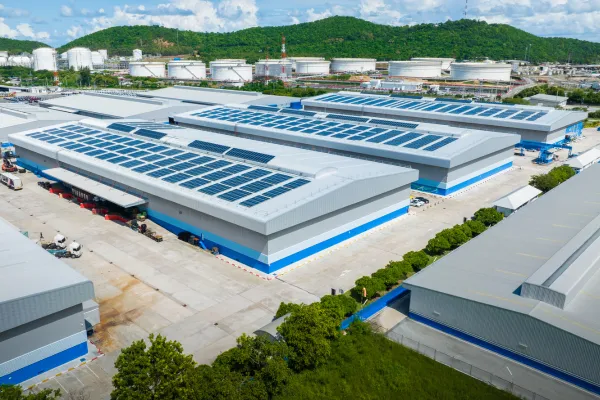
Prologis Crosses 1.3 Gigawatts of Onsite Power, Setting Industrial REIT Benchmark
The world's largest industrial REIT now generates more power on its own roofs than most utilities. Q1 2026 earnings show the model has become the operating system, not a side project.
By Keith Reynolds | Publisher & Editor, ChargedUp!
On April 16th, Prologis (NYSE: PLD) reported first-quarter results that confirmed what the company has been telegraphing since its January 2026 full-year earnings call: rooftop solar and battery storage have moved from a sustainability initiative to a core operating business. The company completed 42 solar and storage projects in the quarter, bringing total installed capacity to 1.3 gigawatts. The data center power pipeline reached 5.6 gigawatts secured or in advanced stages, with 1.3 gigawatts already under letter of intent. At a power shell development cost of approximately $3 million per megawatt, the pipeline alone represents over $15 billion of potential investment, and multiples of that in turnkey format.
These are not aspirational targets. They are deployed capacity numbers from SEC filings, reported alongside $6.9 billion in annual net operating income, $235 billion in gross assets under management, and a record 228 million square feet of leases signed in 2025. Prologis is operating roughly the same scale of distributed generation as a mid-size regional utility, and it is doing so on rooftops it already owns across 1.3 billion square feet of warehouse and logistics real estate.
The Underwriting Math the Filings Show
Prologis disclosed a stabilized weighted average yield of 11.4 percent on its solar and energy storage portfolio. Susan Uthayakumar, Chief Energy and Sustainability Officer, told industry publication Trellis in March that the executive committee approves capital for solar and clean power projects when projected returns reach 11 to 13 percent after stabilization, with a typical 18 to 22 month construction-to-stabilization period. The chief financial officer, she noted, likes the returns and the income.
That is the unvarnished version of the building-level electrification thesis. A development pipeline that yields 11 to 13 percent stabilized in 18 to 22 months, on rooftop space that is already owned and producing rent below the panels, on a property that is already operating as core industrial real estate. The federal incentive stack runs through Investment Tax Credits (ITCs), which Prologis disclosed at $259 million net against the $686 million total enterprise value (TEV) of its solar and storage portfolio. After ITCs, the company's net invested capital in deployed solar and storage assets is approximately $427 million.
Apply that to the asset value math from the 2026 white paper. At an 8 percent capitalization rate, every $1,000 in annual energy savings adds approximately $12,500 in asset value. Prologis is generating energy savings, capacity payments, demand response revenue, and direct power sales across 1.3 gigawatts of deployed capacity. The valuation lift across the portfolio is the line item that the broader CRE industry is now starting to underwrite explicitly, rather than treating as a green premium.
The European Compliance Frame
Starting in 2026, European Union regulations mandate solar installations for new commercial and industrial facilities larger than approximately 2,700 square feet. The average Prologis building is 100,000 square feet. Existing buildings in the EU must add solar by 2027. Uthayakumar told Trellis that for European customers, this is table stakes, and tenants will sometimes refuse a facility that does not have solar in place.
That is the regulatory cliff edge converted into operational reality. EU industrial real estate without rooftop solar is becoming functionally unleasable. The same pattern is forming in California, where Title 24 building energy standards already require solar on most new commercial construction, and in New York where Local Law 97 imposes carbon caps with substantial financial penalties on commercial buildings exceeding emissions thresholds. The compliance dimension matters because it converts the build-or-don't-build question into a defensive necessity rather than an offensive choice. Owners that delay are increasingly exposed to lease-up risk, not just operating cost risk.
The Microgrid Step-Up
In December 2025, Prologis activated its first microgrid-powered logistics facility in Europe, at Almere DC5 in the Netherlands. The site combines rooftop solar, battery storage, and backup generation, managed through Prologis's OnDemand Power platform, a modular plug-and-play system that delivers 400 kilowatts of reliable on-site power. The decision to deploy a microgrid at Almere was forced by grid economics: utility power availability at the site was capped at just 55 kilowatts until at least 2035.
Without the microgrid, the facility would have been functionally unleasable. With it, operations could begin immediately, with solar covering roughly half of annual energy demand. That is the cellular power architecture in commercial real estate. The grid is the redundant resource. The onsite system is the primary one. The framing matters because it inverts the conventional underwriting question. Instead of asking what utility capacity a site has access to, the question becomes what onsite generation the site can host, and how quickly that capacity can be brought online.
Where the Capital Goes Next
Prologis presents at Microgrid Knowledge 2026 in Orlando this week, May 4 to 6, alongside Duke Energy, Schneider Electric, Bloom Energy, NASA, and Wood Mackenzie. The presence on that stage is itself a signal. The largest industrial REIT in the world is not pitching solar to its tenants. It is presenting alongside utilities and equipment manufacturers as a peer in the distributed energy ecosystem, with deployed capacity at gigawatt scale and a forward investment pipeline measured in tens of billions of dollars.
The Q1 2026 disclosure also showed Prologis raising $5 billion in new financing at a 3.75 percent weighted average rate, including a $3 billion credit facility at a 63 basis-point spread, while announcing a $1.6 billion partnership with GIC (Singapore's sovereign wealth fund) and a post-quarter $1.2 billion joint venture with Laquette. The capital is not financing core warehouse acquisitions. It is funding the integrated industrial-and-energy platform that Prologis is building. Sovereign wealth and institutional capital are now writing checks specifically for the energy infrastructure layer of industrial real estate, not for the warehouses themselves.
The Comp for the Rest of the Industry
For owners of commercial industrial real estate operating at any scale below Prologis, the company's disclosures function as a comp set. Three implications stand out. First, the 11 to 13 percent stabilized yield target on rooftop solar is now a published industry benchmark. Owners considering distributed solar deployment can underwrite against that number rather than against speculative ranges. Second, the 18 to 22 month construction-to-stabilization timeline is the operational standard. Projects that exceed that window are running slow against industry-leader execution. Third, the integration with data center power pipeline development (Prologis is positioning warehouses as either data center conversion sites or power campus adjacencies) shows that solar and storage is increasingly the entry point for a much larger energy infrastructure conversation, not the endpoint.
The Section 179D deduction sunsets June 30, 2026 for any project that has not begun construction by that date. For owners not already moving on a portfolio rooftop solar program, the next 56 days are the operational window for the federal deduction stack. After June 30, the same project carries a permanent 15 to 25 percent higher net cost. Section 48E ITC remains available beyond the deadline at 30 percent with PWA compliance, but the combined 179D-plus-48E-plus-bonus depreciation incentive package that delivered roughly 40 to 50 percent total cost offset on Prologis's recent deployments will not be reproducible after the cliff.
The Industrial REIT as Distributed Utility
Prologis Co-Founder, Chairman, and CEO Hamid Moghadam framed the strategic logic explicitly when the company crossed its 1 gigawatt installed milestone in early 2025: the 1.3 billion square feet of premier global real estate represents a significant opportunity to support customers and communities with rooftop solar and energy storage. By Q1 2026, that opportunity is being realized as a $686 million enterprise value portfolio generating distributed power across 18 of the 20 markets where Prologis operates. Solar covers approximately 6 percent of total rooftop area today. The forward runway is the remaining 94 percent.
The structural insight is that the largest industrial REIT in the world has now publicly documented that distributed generation on warehouse rooftops generates competitive returns with Treasury-indexed financial instruments at the same point on the risk curve. That documentation removes the speculative gloss from the entire commercial-and-industrial distributed energy investment thesis. The numbers are SEC-disclosed. The yield is 11.4 percent stabilized. The integration with traditional industrial real estate operations is operational, not theoretical. For any other industrial property owner, the question is no longer whether the model works. It is whether the owner has the procurement infrastructure to execute on a portfolio scale before the federal incentive window closes.
The June 30 deadline is 56 days away.
Sources
Microgrid Knowledge 2026 conference program — https://www.microgridconferences.com/2026/program
Prologis Almere microgrid case study (December 2025) — https://www.prologis.com/insights-news/blog/prologis-unveils-its-first-microgrid-powered-logistics-facility-europe
Prologis Q1 2026 8-K SEC filing — https://www.sec.gov/Archives/edgar/data/1045609/000119312526157977/pld-ex99_1.htm
Prologis Q1 2026 earnings call transcript (Motley Fool) — https://www.fool.com/earnings/call-transcripts/2026/04/16/prologis-pld-q1-2026-earnings-call-transcript/
Prologis Q4 2025 results press release (January 21, 2026) — https://www.prologis.com/insights-news/press-releases/prologis-reports-fourth-quarter-and-full-year-2025-results
Solar Power World on Prologis SolarCycle partnership (March 2026) — https://www.solarpowerworldonline.com/2026/03/logistics-real-estate-brand-prologis-taps-solarcycle-for-pv-end-of-life-plans/
Trellis on Prologis solar economics (March 2026) — https://trellis.net/article/how-prologis-makes-money-from-on-site-solar/
