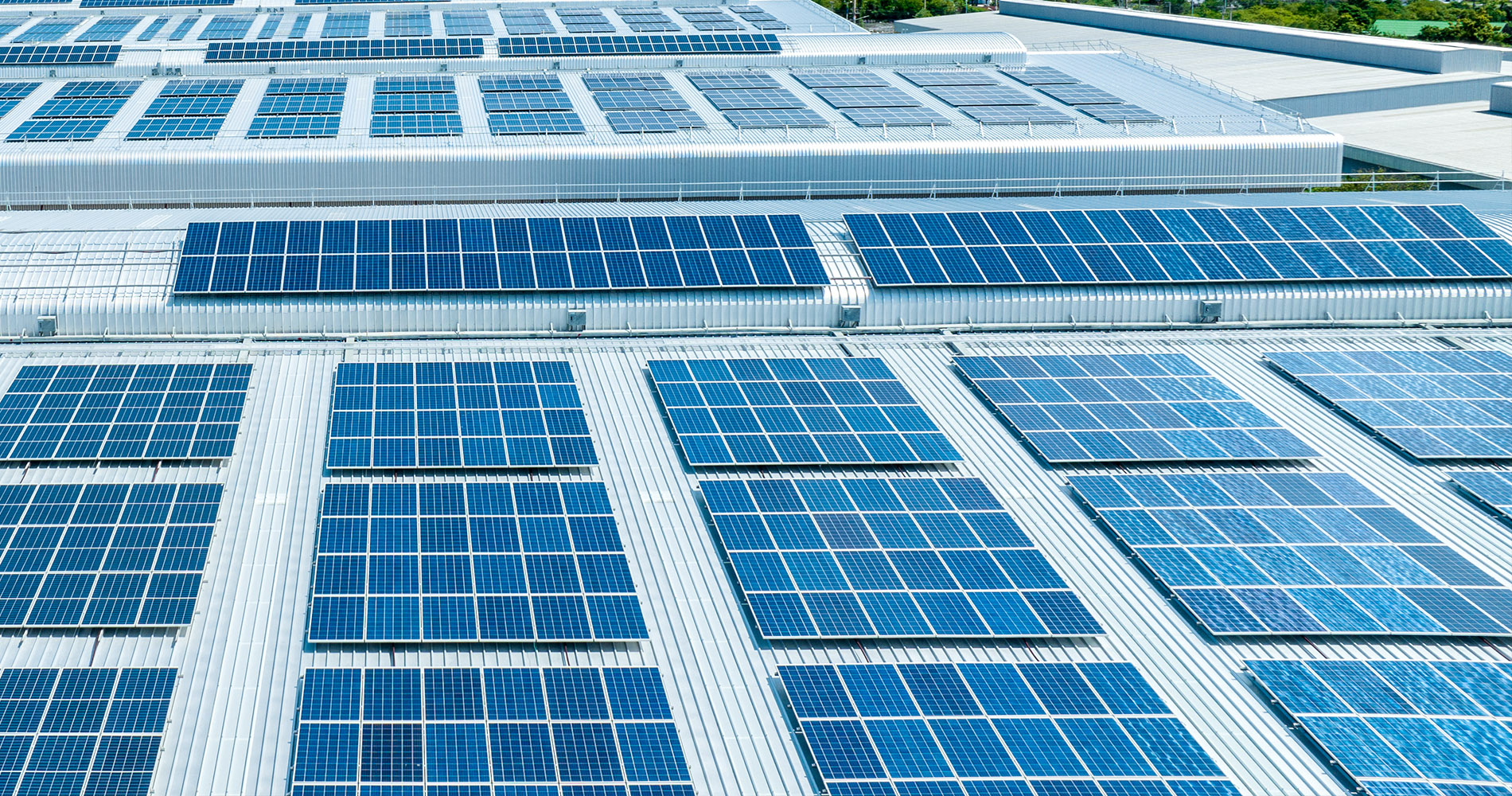
REIT Solar Portfolio Lights a Path for the Distributed Power Era
Luminia energized 57 commercial rooftops in under a year for one publicly traded REIT. The model translates rooftop economics into NOI math the building owner can actually run.
By Keith Reynolds | Publisher & Editor, ChargedUp!
This past March, San Diego-based renewable energy developer Luminia announced the completion of a 3.8 megawatt rooftop solar portfolio spanning 57 commercial properties owned by a leading publicly traded real estate investment trust (REIT) with holdings across the United States. The portfolio sites are located in California, Texas, and Michigan and are occupied by national-brand commercial tenants. Ten additional sites totaling 6.5 megawatts are scheduled for construction in California, Illinois, and Massachusetts during 2026, bringing the full portfolio capacity to over 10.3 megawatts.
The technical achievement is real but secondary. The bigger story is the speed and the structure. All projects in the initial 57-site portfolio were designed, permitted, built, and energized within 12 months of the execution of the respective Power Purchase Agreements (PPAs), a pace Luminia called rare in distributed commercial solar. For a REIT operating in three states with national-brand tenants paying triple-net rent, the deliverable is not megawatts. It is a repeatable financial model that converts rooftop square footage into a 25-year revenue and savings stream without disturbing the underlying lease.
The Financial Architecture
Luminia Co-founder Jim Kelly described the program as demonstrating that distributed rooftop solar power can be delivered with speed, scale, and operational precision across large commercial real estate holdings. The structure that makes that work has three components. First, Luminia provides end-to-end project delivery from origination through permission to operate and Investment Tax Credit placement. Second, the company uses a proprietary production monitoring and tenant billing platform that allows the REIT to allocate energy savings across multiple tenants with accuracy and transparency. Third, the underlying agreement is typically a 25-year lease with two five-year extension options, structured so existing roof warranties remain intact and the system is removed at the developer's cost at the end of the term.
For the REIT, this means the rooftop generates revenue (or offsets tenant electricity cost, depending on the lease structure) for 25 years without consuming the REIT's own capital and without disrupting tenant operations. The systems are expected to deliver a significant portion of electricity supply for each participating property over that 25-year horizon.
Why Speed Matters More Than Megawatts
The 12-month design-to-energization pace deserves its own paragraph because it inverts the standard commercial solar timeline. Conventional commercial rooftop projects in California, Texas, and Michigan routinely take 18 to 30 months from PPA execution to permission to operate, with interconnection queues, structural reviews, AHJ permitting, utility-side equipment availability, and tenant coordination each contributing delay. A 57-site portfolio executed in 12 months across three states implies the developer pre-solved most of the friction points before the first PPA was signed.
The implication for REITs and large commercial portfolio owners: distributed solar is no longer a one-off site decision that takes years to underwrite. With the right development partner, a portfolio program can be designed, financed, and delivered on a schedule that matches the REIT's annual capital planning cycle. That is the structural difference between solar as an experiment and solar as a portfolio strategy.
The NOI Math the Owner Has to Run
At an 8 percent capitalization rate, every $1,000 in annual energy savings generates roughly $12,500 in asset value. For a 100,000-square-foot commercial building in a market like California or Texas where electricity rates have risen 15 percent to 35 percent over the past three years, a meaningful rooftop solar program can produce $25,000 to $60,000 in annual savings depending on roof size, solar resource, and offtake structure, which translates to $312,500 to $750,000 in valuation lift per asset.
Multiplied across 57 properties, the portfolio-level valuation impact is the kind of number that registers in REIT financial reporting. It also moves the conversation from environmental positioning to balance sheet economics. The participating REIT was not described in the announcement, but the structure makes clear that the motivation is reduced tenant electricity cost and stable long-term energy supply, not certification or marketing.
The Tenant Allocation Problem, Solved
The technical wrinkle that has historically blocked REIT-scale solar deployment is tenant allocation. In a multi-tenant property, who gets the solar electricity, on what terms, and how are the savings split? Triple-net leases push utility costs to tenants, which means the landlord generating onsite solar must either credit the tenant directly, restructure the lease, or operate as a private power provider behind the meter.
Luminia addresses this through its proprietary production monitoring and tenant billing platform, which allows energy savings to be allocated across multiple tenants with transparency. That platform is the operational glue that lets a REIT deploy solar across 57 buildings with national-brand tenants without renegotiating 57 leases. Without it, the program would not exist at this scale.
The Section 179D Window
Section 179D of the federal tax code allows a deduction of up to $5.94 per square foot in 2026 for energy-efficient commercial building improvements meeting Prevailing Wage and Apprenticeship (PWA) requirements and achieving 50 percent energy savings against the ASHRAE 90.1-2022 baseline. For a 100,000-square-foot building, the maximum deduction is $594,000.
The Section 179D benefit terminates for any property where construction begins after June 30, 2026. Combined with the Section 48E Investment Tax Credit (ITC) for the solar generation itself (30 percent of cost basis with PWA, with potential bonus adders for Energy Communities and Domestic Content), the federal incentive stack on a portfolio program executed before the deadline can offset 40 percent to 50 percent of total project cost. After June 30, the 179D component disappears and the economics shift permanently.
That deadline is what makes the speed of Luminia's 12-month delivery program operationally meaningful, not just impressive. Portfolio owners who execute PPAs in May or June 2026 with a developer that has demonstrated 12-month delivery can realistically begin construction before the sunset and capture the full incentive stack. Portfolio owners who wait until Q3 2026 to start the procurement conversation will not.
The Broader Pattern
Luminia is one of several developers operating this portfolio-program model. Pivot Energy, Catalyze, Nautilus Solar, and Safari Energy each run variants for institutional commercial owners, with structural differences in financing, ownership, and tenant billing. The common thread is that distributed commercial solar has matured from a project-level decision to a portfolio-level program. The REITs and large commercial owners who treat it as the latter are building energy infrastructure assets on existing real estate at a marginal cost that goes negative once the federal incentive stack is monetized through ITC transfer.
For a CRE owner whose assets average $1.86 to $1.90 per square foot in annual energy spending, the question is no longer whether the math works. It is whether the procurement and execution capacity exists internally to run a portfolio program before June 30. For most owners, the answer is to find a developer that has already done it.
Sources
AltEnergyMag coverage — https://www.altenergymag.com/news/2026/03/10/luminia-completes-a-57-site-38-mw-rooftop-solar-portfolio-for-leading-national-reit-in-under-a-year-with-another-65-mw-in-development-over-10-additional-sites/46881/
Clean Energy Alliance partnership announcement — https://cal-cca.org/clean-energy-alliance-partners-with-luminia-to-expand-solar-and-battery-storage-across-northern-san-diego-county/
Luminia Solar Plus Business program details — https://luminia.io/solar-plus-business/
Luminia press release (March 10, 2026) — https://www.prweb.com/releases/luminia-completes-a-57-site-3-8-mw-rooftop-solar-portfolio-for-leading-national-reit-in-under-a-year-with-another-6-5-mw-in-development-over-10-additional-sites-302707916.html
Section 179D 2026 deduction parameters — https://www.energy.gov/eere/buildings/179d-commercial-buildings-energy-efficiency-tax-deduction
