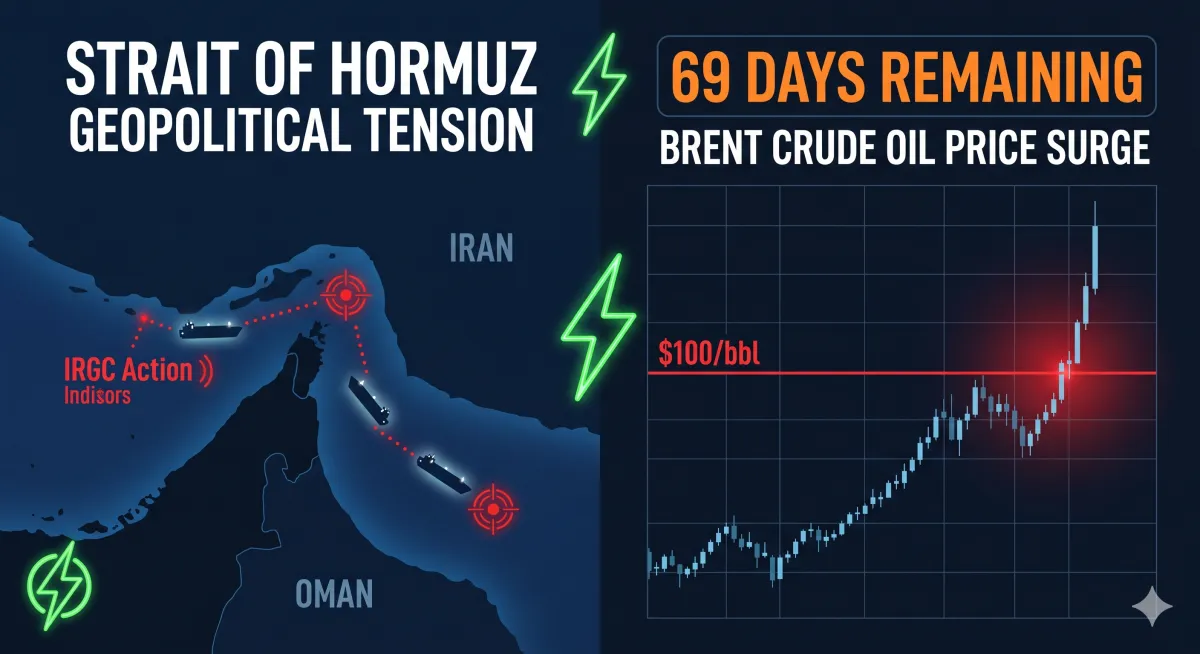
The Unstable Equilibrium Just Broke: Iran Seizes Three Ships as Brent Crosses $100
IRGC forces fired on and seized the MSC Francesca and the Epaminondas in the Strait of Hormuz this morning. A third vessel, the Euphoria, ran aground on the Iranian coast. Brent touched $101. The ceasefire Trump extended yesterday now has no practical meaning on the water.
Meanwhile, both the Section 179D construction-start and Section 30C service deadlines are June 30, just 69 days away. Removal of these incentives will directly impact the internal rate of return (IRR) for many developments. Established by the One Big Beautiful Bill Act (OBBBA), the planning window shifts how commercial real estate (CRE) owners and investors model project returns and manage capital.
By Keith Reynolds | Publisher & Editor, ChargedUp!
Mohamed El-Erian described this week's diplomatic sequence yesterday as the extension of an “unstable equilibrium.” That equilibrium broke on the water before American markets opened Wednesday morning. The Islamic Revolutionary Guard Corps Navy fired on and seized two commercial container vessels in the Strait of Hormuz, the MSC Francesca and the Epaminondas, transferring both to the Iranian coast for what IRGC officials described as examination of cargo and documents. A third vessel, the Euphoria, was reported stranded on the Iranian coast by Iran's semiofficial Fars and Mehr news agencies. The United Kingdom Maritime Trade Operations Centre confirmed the MSC Francesca was attacked by an IRGC gunboat that did not hail the ship before opening fire.
All three vessels are linked to MSC, the Geneva-based container shipping line, and were among six MSC ships Linerlytica had reported transiting the Strait with their AIS transponders switched off. The IRGC Navy statement framed the seizures as interdiction of vessels attempting to secretly exit the Strait. In practical terms, the seizures are the clearest possible answer to Trump's Tuesday afternoon ceasefire extension: Iran did not request the extension, Iran is not negotiating under the shadow of a blockade, and the physical Strait of Hormuz is now the contested space regardless of what Washington or Islamabad announce from podiums.
As of Wednesday morning, April 22, 2026, both oil prices and U.S. equity markets are rising, defying typical inverse correlations as investors weigh an extended Iran ceasefire against renewed geopolitical tensions in the Strait of Hormuz. Brent crude futures for June delivery rose above $101 per barrel during European trading this morning, up more than 5 percent from Tuesday's close, before settling near $99 to $100 as U.S. markets prepared to open. WTI crossed $91 and trades near $90.26 to $91.22. Equity futures remained constructive on the extension narrative. S&P 500 futures indicated a 0.68 percent higher open, Dow futures pointed up 0.66 percent or roughly 335 points, and Nasdaq futures were up 0.86 percent. The 10-year Treasury yield eased to 4.28 percent from 4.31 percent yesterday. The split between oil and equities is the market pricing two different things at once: supply risk that is compounding on the water, and relief that a full-scale U.S. airstrike did not resume overnight.
This is Part 8 of an ongoing series. The structural arguments for why distributed energy investment is the optimal response to this crisis regardless of diplomatic outcome are developed in full in the ChargedUp! anchor white paper, The Energy-Equity Connection. This installment focuses on what has changed in the last twelve hours, what the three seizures mean for supply math, and the 69-day runway commercial owners have to the June 30 statutory deadline.
What Changed Before Markets Opened
Tuesday afternoon, Eastern time: Trump posted an indefinite ceasefire extension to Truth Social, directing the U.S. military to continue the blockade. Iran had not requested the extension. The Islamic Revolutionary Guards-linked Tasnim News Agency confirmed that point within hours and reported that Iran had informed U.S. counterparts through an intermediary in Pakistan that Iranian negotiators would not attend further talks. Vice President Vance's planned departure for Islamabad, first scheduled for Tuesday morning and then rescheduled for Tuesday evening, was postponed indefinitely. An adviser to Iranian Parliament Speaker Mohammad Baqer Ghalibaf called the extension a ploy to buy time for a surprise strike and said it means nothing.
Wednesday morning, Strait of Hormuz: IRGC gunboats fired on three commercial vessels and seized two. The Epaminondas was struck roughly 15 nautical miles northeast of Oman, suffering heavy damage to its bridge. The MSC Francesca was fired on approximately six nautical miles off the Iranian coast while transiting southbound. The IRGC identified the MSC Francesca as Israeli-owned, a characterization the owner has not confirmed. The Euphoria was reported stranded on the Iranian coast under circumstances Iranian state media has not elaborated. The UKMTO issued a high-activity warning for the Strait.
Treasury Secretary Scott Bessent told reporters Tuesday that oil storage at Iran's Kharg Island terminal, which handles approximately 90 percent of Iranian crude exports, will be full within days. CENTCOM reports that 23 vessels have been forced to reverse course under the blockade since it went live on April 13. More than 200 loaded tankers are reported stuck in the Persian Gulf, unable to pass normally through the Strait. The blockade is costing Iran an estimated $500 million per day in lost export revenue. The three seizures this morning are the first direct IRGC action against commercial traffic since the Tuesday extension and are the clearest signal available that the Iranian position on the Strait has hardened rather than relaxed.
Oil Prices Signal Two Things
The first signal from the oil market is is that supply risk is now the binding constraint. Brent touching $101 during European hours is not a reaction to a political announcement, rather, it is a reaction to three ships being fired on and two being seized inside the space of a few hours in the world's most important energy chokepoint. Freight insurance premiums through the Strait were already running at more than 5 percent of vessel value, roughly 100 times the prewar baseline. Every incident of direct IRGC fire on commercial traffic pushes those premiums higher and pushes more tonnage out of the transit queue. The physical supply contraction compounds. The IEA April Oil Market Report revised global oil demand from growth of 640,000 barrels per day to a contraction of 80,000 barrels per day. That is a demand-destruction story, and Brent still held above $99.
The second signal is that the equity market is pricing relief, and the oil market is pricing duration. Dow futures up 335 points reflects the absence of a full-scale U.S. airstrike overnight. Brent at $100 reflects an assessment that the blockade will continue, Iran will not attend talks under it, and Kharg Island will fill within days. Both of those things can be true simultaneously. The EIA Short-Term Energy Outlook forecasts Brent peaking near $115 per barrel in the second quarter of 2026. That forecast was issued before the Wednesday morning seizures. The directional signal is unchanged, and the floor under the price has just moved up.
For commercial property owners, the relevant number is not the Brent quote. It is the pass-through into utility fuel adjustment clauses over the next two quarters, the effect of sustained $100 crude on the gas generation mix that PJM, MISO, and ERCOT depend on, and the rate cases already filed or in settlement. Those rate cases do not reverse on a ceasefire extension announcement and they compound on oil staying above $95. The market has been telling us this since February. The three seizures this morning are the confirmation.
What Breaks at the Building Level
Utility capacity markets are already locked in through the 2027 and 2028 delivery years. The PJM capacity auction cleared in December at $333.44 per megawatt-day, the FERC-approved cap, with data center demand accounting for approximately $6.5 billion of the $16.4 billion cleared total. PECO filed a $429 million rate hike with the Pennsylvania PUC on March 30. PPL settled at $275 million including a 10-year Data Center Tariff template that will spread across the rest of PJM. Xcel Colorado is seeking $356 million. Xcel Minnesota is seeking $574 million over two years. The Center for American Progress rate case tracker counts 242 utilities pursuing increases that touch 111.5 million customers.
These filings are not reversed by a ceasefire extension. They are accelerated by sustained crude above $95. Gas-fired generation represents 43 percent of the cleared PJM capacity mix and every dollar of Brent flows through into the fuel adjustment clauses that determine retail rates. The mechanics by which utility rate exposure converts into cap rate pressure, and the structural case for distributed energy as the hedge, are developed in The Energy-Equity Connection, the ChargedUp! anchor white paper on how distributed energy converts floating utility cost exposure into a fixed capital investment with federal incentive offsets.
Section 48E Investment Tax Credit at 30 percent for qualifying behind-the-meter solar and battery storage projects continues to apply, stackable with domestic content and energy community adders. Section 179D maximum of $5.94 per square foot, which translates to $594,000 on a 100,000-square-foot building, expires for construction starts after June 30, 2026. Section 30C commercial charging credit at 30 percent of installation cost up to $100,000 per location expires the same day. Restored 100 percent bonus depreciation under the One Big Beautiful Bill Act applies to qualified energy equipment acquired after January 19, 2025.
Three Strategies Already in Motion
First, the long-duration master lease. The PearlX and Metonic Energy Estate at Millennium Apartments, a 977-kilowatt solar system placed into full commercial operation at the 330-unit Palm Desert property on April 9 under a 25-year master lease, is the production template. Zero capital outlay to the owner. Owner takes rent; residents take lower energy costs. The structure is replicable across multifamily portfolios in high-rate markets.
Second, project-level solar-plus-storage positioned for incentive stacking. PowerBank's 5-megawatt hybrid system in upstate New York, announced April 13, is structured to capture NYSERDA NY-Sun Program incentives and the Retail Storage Incentive Program simultaneously. The structure converts state-level program economics and the federal ITC into a single revenue stack that underwrites the project independent of wholesale utility pricing.
Third, virtual power plant participation through new utility tariffs. Illinois ComEd launched Rider VPP, Rider BYODLR, and Rider CSS this spring under the Clean and Reliable Grid Affordability Act. Colorado's Xcel Active Virtual Power Plant program is rolling out at $624 per kilowatt for aggregator-enrolled behind-the-meter DERs, compared with $2,150 per kilowatt for utility-owned batteries. Commercial portfolios with existing storage in those footprints can convert idle assets into capacity revenue against the same PJM pricing that is driving the utility rate hikes. The common thread across all three strategies is the same: each trades optionality for certainty at a moment when certainty is the rare asset class.
The 69-Day Runway and the Detroit Close
The Section 179D construction-start deadline and the Section 30C service deadline both land on June 30, 2026. From this morning, that is 69 days. Transformer lead times at 128 weeks and hyperscaler procurement queues absorbing commercial-grade electrical equipment through 2027 compress the practical project-start window inside that 69-day statutory one. Projects that have not broken ground need site control, utility interconnection signaling, and equipment procurement locked by the end of May to stand any reasonable chance of capturing the incentive.
For owners without an onsite generation plan on the books, the question is no longer whether distributed energy improves NOI. It is whether the statutory runway is long enough to capture the federal incentive, and what contingency protects the asset if the runway runs short. The operational answer for most portfolios is a hybrid: safe-harbor what can be safe-harbored now, structure long-duration master lease agreements for what cannot, stack state-level program economics where the footprint supports it, and underwrite against rate case filings that are already in the record rather than against the prewar utility baseline.
For planners and municipal officials, the unstable equilibrium reaches the built environment through zoning, interconnection standards, and utility rate class design. Virginia's reconvened session opens in Richmond today to act on Governor Spanberger's data center cost-shift amendments. FERC's April 30 deadline on large-load interconnection under docket RM26-4-000 lands eight days from today. Maine's LD 307 sits on Governor Mills' desk. These policy motions proceed on their own timelines regardless of what happens in Islamabad or the Strait of Hormuz. The communities that update their tools during the current window capture the capital that the oil shock is already redirecting out of passive ownership and into resilient, generation-capable assets.
The ChargedUp! Pavilion at the American Planning Association's National Planning Conference (NPC26) opens in Detroit this Saturday, April 25 and runs through Monday April 28. The second round of Islamabad talks may or may not reconvene by then. The Kharg Island storage will be closer to full. The June 30 statutory clock will read 66 days. The owners and planners working these questions together in the same room, on the same floor, are the ones most likely to leave the week with an actionable path forward. Join us.
Sources and Further Reading
ABC News: Iran live updates — Ships attacked in Strait of Hormuz after Trump ceasefire extension
Al Jazeera: Trump announces Iran ceasefire extension but says blockade remains
AP via Gazette: Iran fires on 3 ships in the Strait of Hormuz (April 22, 2026)
Axios: Vance's Pakistan trip postponed indefinitely as Iran boycotts peace talks
CENTCOM: U.S. to Blockade Ships Entering or Exiting Iranian Ports (April 12, 2026)
Euronews: Iran seizes two cargo ships in Strait of Hormuz after three vessels fired on
Seatrade Maritime News: Three container ships come under fire from Iran in Hormuz
