The True Cost of Power: Oil Fell Again on Hopes of a Deal. Why Didn't the Cost of Power Move With It?
By Keith Reynolds | Publisher & Editor, ChargedUp!
Because the two costs run on different clocks. Oil fell this week on news of diplomatic talks, then spiked back overnight when the fighting resumed, the sixth such swing of this conflict in a matter of months. The cost of powering a building runs on a slower, deeper clock set by a power grid that cannot connect new users fast enough. The wait to connect a large new building or factory to the grid now averages about five years and reaches far longer in strained regions. That wait does not shorten when a ceasefire is announced or lengthen when one collapses. It has quietly become the single biggest constraint, and cost, in bringing a powered building to market.
The Oil Story Repeats Itself
Brent crude, the global benchmark, fell to around $84 a barrel this week, its lowest in more than a week, after renewed diplomatic efforts over the Strait of Hormuz and comments from President Donald Trump that Washington was holding good talks with Tehran, according to market data. It was a familiar move. Just last week oil had pushed toward $95 on escalation; this week it gave much of that back on hopes of a deal, even as Iran rejected a proposal for shared control of the strait and drones still targeted Saudi oil facilities. This is the fifth time in this conflict that a diplomatic headline has produced a relief trade, and each one has faded when the next escalation arrived.
An owner who set property strategy by these swings would have whipsawed five times this year. The price of oil is real, and it matters to fuel, shipping, and construction materials. But as a guide to long-term decisions about a building, it is noise. It appears and disappears in a single trading session. The cost that actually shapes a building's future moves far more slowly, and this week it did not move at all.
The Clock That Actually Matters
That deeper cost is best measured in time. Before a new building, factory, or data center can draw significant power, it has to connect to the grid, and the line to do so has become extraordinarily long. More than 2,000 gigawatts of new power projects are now waiting in United States interconnection queues, the formal lines to connect to the grid. A single gigawatt is roughly the output of a large power plant, so the backlog represents more than the entire installed power capacity of the country. The typical project now waits about five years from application to switch-on, according to Lawrence Berkeley National Laboratory research, up from under two years in 2008. In the most constrained regions, the wait stretches to seven years and beyond.
The delay is not a paperwork problem that a reform will soon fix. It reflects a physical shortage of grid capacity colliding with the fastest demand growth in decades. Of all the projects that requested connection between 2000 and 2019, only about 19 percent had reached commercial operation by the end of 2024. Nearly 80 percent of projects eventually withdraw, often because the wait is too long or the cost of the required grid upgrades, which can run 30 to 37 percent of a project's entire budget, destroys the economics. For an owner, a five-year wait to power a building is not a delay. It is a cost, and frequently a deal-killer.
Why This Is a Cost, Not Just a Wait
A construction timeline and a power timeline that do not match is one of the most expensive problems in development, and the mismatch has become severe. A commercial building or data center can be designed and built in roughly 12 to 24 months. If the power to run it takes five years to arrive, the building sits finished and dark, carrying debt and earning nothing, for years. Every month a completed building waits for power is a month of financing cost with no income against it, and in a period of high interest rates, that carrying cost is punishing.
This is where the war and the grid, the cyclical cost and the structural one, finally connect. Both push in the same direction: they raise the cost and lengthen the timeline of getting a powered building to market. But only one of them can be managed by the owner. No one can shorten the war. The power timeline, by contrast, can be attacked directly, and that is where distributed energy stops being an environmental preference and becomes a scheduling tool.
The overnight spike carried a second sting worth naming, because it is the war's real path into real estate. When oil jumps, it revives fears of inflation, and those fears push up interest rates. The yield on the 10-year Treasury note, the benchmark that sets borrowing costs across the economy, climbed to about 4.6 percent this week, its highest since the spring, as the oil spike rekindled inflation concern, with markets now pricing roughly an 80 percent chance the Federal Reserve raises rates in September. Higher borrowing costs make every debt-financed project more expensive and press down on property values. So the war does reach a building, but through the cost of money, not the cost of electricity, and a building already saddled with a five-year wait for power feels that squeeze twice.
Behind the Meter Beats the Queue
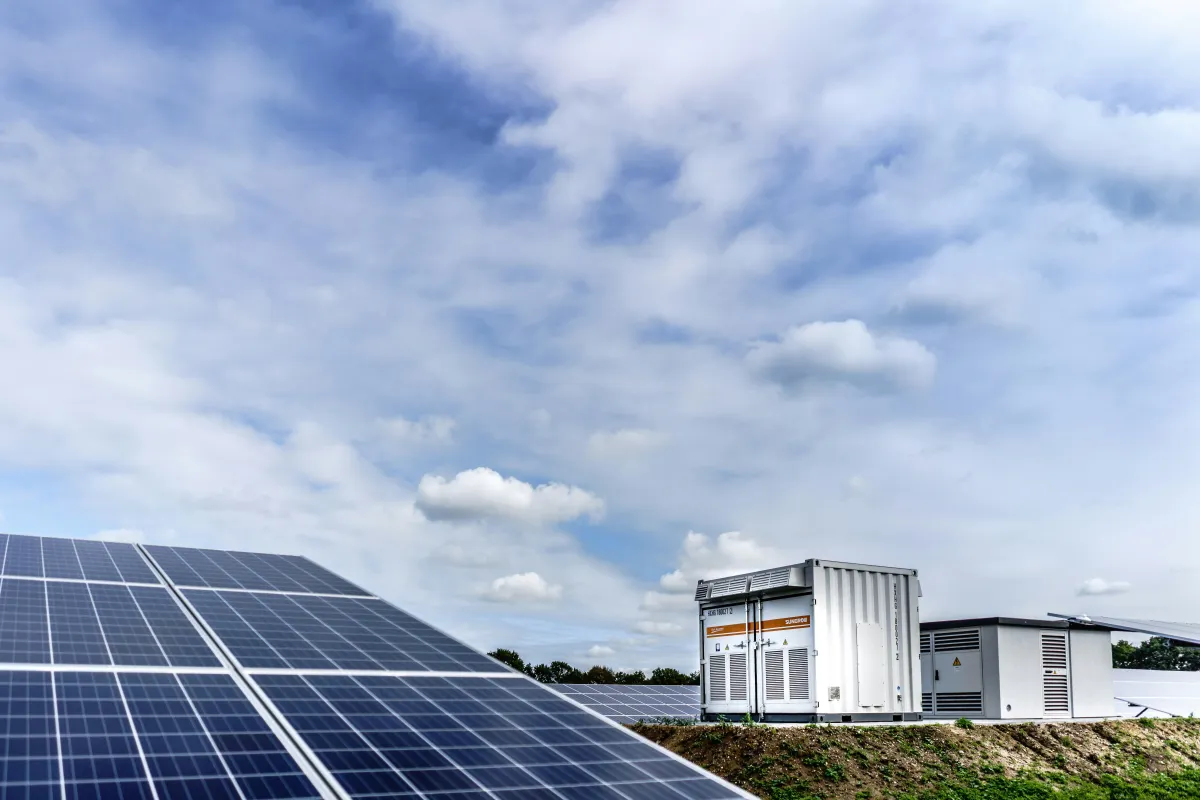
The fastest-growing response to the queue is to skip it. Building generation onsite, behind the meter in industry terms, means a property makes its own power rather than waiting years for the grid to deliver it. onsite generation converts a five-to-seven-year utility wait into a 12-to-36-month equipment delivery and commissioning schedule, per multiple 2026 industry analyses. For a project that must open in 2027 or 2028, that difference is not a nicety. It is the difference between opening on schedule and not opening at all.
The largest power users are already voting with their capital. The Boston Consulting Group projects that more than 35 gigawatts of data center power will be self-generated by 2030, a direct response to queue timelines that exceed construction periods. Costco has taken several of its own facilities entirely off the grid to avoid exactly this wait. The pattern this publication has tracked for months, big power users pairing themselves with their own generation, is at its core a race against the interconnection clock, and distributed solar, storage, and onsite generation are how they win it.
There is an honest tradeoff. Building generation on site carries a higher upfront capital cost than a simple utility connection, on the order of a few million dollars more per megawatt by some 2026 estimates. But that comparison misses the timeline. A utility connection that is cheaper on paper but arrives five years late, after five years of carrying a dark building, is far more expensive in any real calculation than onsite power that arrives in eighteen months and starts earning immediately. Speed, in this market, is the dominant term in the equation.
What the Structural Cost Means for a Building's Value
The connection to property value is direct. A building that can be powered quickly is worth more than an identical building that must wait years for the grid, because the fast building starts earning income sooner and carries less risk. As the queue lengthens across the country, the ability to power a site becomes a distinguishing feature of the asset itself, the way location or access once was. A parcel with existing power capacity, or a design that can generate its own, commands a premium precisely because it escapes the wait that traps everything around it.
The math that anchors this series still holds. At an 8 percent capitalization rate, every $1,000 of durable annual energy cost a building removes from its operating statement adds roughly $12,500 to its value. But this week's lesson adds a second dimension to that arithmetic. It is not only the ongoing energy savings that create value. It is the years of financing cost avoided by powering a building on time rather than late. In a market where the grid cannot keep up, the owner who controls the power timeline controls the schedule, the carrying cost, and ultimately the value.
A Practical Way to Think About It
For an owner or developer weighing a project in the current environment, the sequence is straightforward.
Ask about the power timeline first, not last. Before committing to a site, find out how long the local utility will take to deliver the power the project needs. In many regions the answer will reshape the whole plan.
Price the wait, not just the connection. Compare the cheaper utility connection against the carrying cost of a finished building sitting dark for years. The onsite option that looks more expensive per megawatt is often far cheaper once the timeline is counted.
Design for onsite generation early. Solar, storage, and onsite generation are far cheaper and simpler to build into a project from the start than to add later. Reserve the roof, the land, and the electrical room now.
Treat power access as an asset feature. A site that can be powered on schedule is worth more than one that cannot. Underwrite it that way, and market it that way.
The Bottom Line
Oil will rise and fall on the next headline out of the Gulf, and it will do so again after that. Those swings deserve attention from anyone buying diesel or shipping goods, but they are the wrong clock to set a building by. The clock that matters ticks in years, not trading sessions, and it measures how long a building must wait for power it cannot yet get. That wait is lengthening, it will not be resolved by any ceasefire, and it is quietly becoming the most expensive line in development. The owners who come through this period well are the ones who stop watching the price of oil and start controlling the timeline of their own power.
Frequently Asked Questions
Why did oil move so much this week?
Brent fell toward $84 a barrel on hopes of a diplomatic deal over the Strait of Hormuz, then spiked back toward $90 overnight when Iran struck at U.S. forces and the president promised to retaliate. It is the sixth such swing of this conflict. The spike also pushed the 10-year Treasury yield to about 4.6 percent, its highest since spring, raising borrowing costs across real estate.
How long does it take to connect a new building to the grid?
The typical large new electricity load now waits about five years from application to operation, up from under two years in 2008, and longer in strained regions. More than 2,000 gigawatts of projects sit in U.S. interconnection queues.
How does onsite generation help?
Building power onsite, behind the meter, can convert a five-to-seven-year utility wait into a 12-to-36-month schedule. It costs more upfront per megawatt but avoids years of carrying a finished building that cannot earn income while it waits for power.
Why does the power timeline affect a building's value?
A building that can be powered quickly starts earning sooner and carries less risk than one that waits years. As grid queues lengthen, the ability to power a site becomes a distinguishing asset feature, and every $1,000 of durable annual energy savings adds roughly $12,500 in value at an 8 percent cap rate.
