Ohio Village Becomes First in America to Install Japan's Ecomo Energy-Saving Device
By Keith Reynolds | Publisher & Editor, ChargedUp!
The Short Version
Richfield, Ohio, is the first place in the United States to install the Ecomo, an energy-saving device made by Japan's Yuasa International. Yuasa president Yusuke Hino donated four Ecomo units to the village to be installed on the police and fire station and several sewer pump systems. Mayor Mike Wheeler calculates the units will save the village about $5,283 a year on electricity, money he plans to return to the general fund. The installation grew from a chance meeting between Hino and the Mayor at an Ohio factory tour, and it now anchors a wider municipal strategy that includes exploring further cuts across municipal buildings and a pause on new data center development.
Key Facts at a Glance
First US installation: Richfield, Ohio is the first American location for Yuasa International's Ecomo energy-saving device.
Four units donated: Yuasa president Yusuke Hino donated four Ecomo units, installed on the police and fire station and several sewer pump systems.
Projected savings: Mayor Mike Wheeler calculates about $5,283 a year, returned to the general fund. A six-month data review will confirm it.
How it works: The device uses natural minerals, tourmaline and ferrite, to cut electrical loss between a transformer and the equipment it powers, with no electronics and no maintenance.
The guarantee: Ecomo targets a 5 to 15 percent cut in transmission loss, with a 5 percent minimum, and installs in 30 to 60 minutes.
Broader goal: The village is exploring further electricity cuts across its municipal buildings.
Policy stance: Richfield has paused new data center development to reassess zoning over resource and revenue concerns.
Origin: The partnership began when Hino met Mayor Wheeler at a JETRO manufacturing tour in Ohio.
How Did the Yuasa and Richfield Partnership Begin?
The story begins with a conversation, not a sales pitch. Yusuke Hino, president of Yuasa International, met Richfield Mayor Mike Wheeler during a manufacturing facility tour in Ohio hosted by the Japan External Trade Organization (JETRO), a Japanese government agency that promotes trade and investment, as recounted by the Yuasa team. The two began talking about sustainability, and because Yuasa had recently started carrying energy-saving products, the conversation turned to what the company could offer a community like Richfield.
Business discussions followed through late 2025. In December, a Yuasa delegation including Kenichi Kato and members of the company's team visited Richfield to introduce themselves and demonstrate the Ecomo. Mayor Wheeler showed immediate interest and moved quickly to begin a project. Over the following months, the two sides gathered data on potential installation sites, and a Yuasa representative traveled to Richfield to confirm the conditions at each location before installation. The result made the village the first adopter of the Ecomo device in the United States, turning a small Ohio community into a proving ground for a technology new to the American market.
What Is the Ecomo Device and How Does It Save Energy?
This feature builds on our spring report on the Ecomo and the guaranteed-savings model behind it. Here’s a brief summary on how the device works and why it appeals to municipalities:
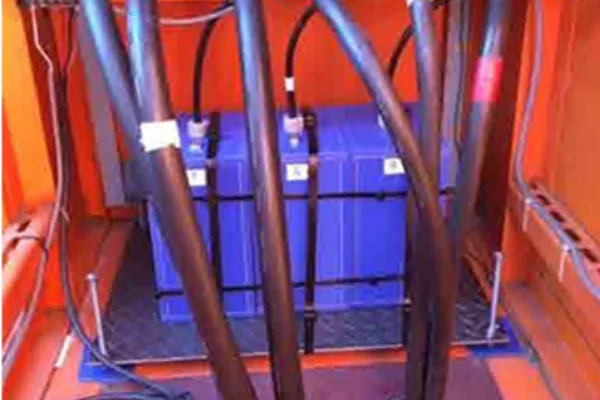
The Ecomo is a transformer-level device that reduces the electricity a building wastes before it ever reaches the equipment that uses it. As detailed in our spring report, it targets the electrical loss that occurs naturally between a facility's transformer, the equipment that steps utility voltage down to a usable level, and the load that consumes the power, as Yuasa describes it. It connects to the secondary side of the transformer and installs in 30 to 60 minutes with no major retrofit and no ongoing maintenance.
The mechanism relies on two natural minerals rather than any electronics. Tourmaline, a mineral known in Japanese as the electric stone, releases a small stream of free electrons that reduce resistance in the wiring, letting current flow more smoothly. Ferrite, a magnetic material, absorbs the electrical noise that transformers generate and that otherwise wastes power. Because no electricity flows through the unit itself, there are no capacitors or chips to degrade, which is why Yuasa backs it with a seven-year manufacturing warranty and reports it running semi-permanently across approximately 2,300 locations across 10 countries, mostly in Japan, Vietnam and Southeast Asia, where energy is scarce. The company guarantees a reduction of at least 5 percent in transmission loss, targeting a range of 5 to 15 percent.
Yuasa frames the value in business terms rather than engineering ones. Max DeCapri, a Yuasa sales manager who joined the company after studying renewable energy in Japan, told ChargedUp! in the spring that the device reframes the efficiency question entirely. Instead of asking whether to undertake a major, multi-year energy retrofit, a facility can ask a smaller question: whether to test a targeted efficiency measure that can be validated against its own data. For a building spending heavily on power each month, that lower-friction path to savings is often the more persuasive one.
What matters for our audience is the financial logic. A device that reduces a building's electricity use lowers its operating cost, and for a municipality, that saving flows straight back into the budget for other priorities. The same logic that makes onsite generation attractive to a commercial owner, a lower and more predictable power cost, applies to an efficiency device in a public building. The dollars saved are dollars freed.
How Much Is Richfield Saving So Far?
The first results are encouraging, with the caveat that the full accounting is still being compiled. Mayor Wheeler has calculated that the four donated units will save the village about $5,283 a year on electricity, and he has been specific about where that money goes. It returns to the general fund, he told a local broadcaster, to be used for a range of needs including the replacement and repair of the village's sewer pumps, as reported by Cleveland 19 News. The figure is the Mayor's own projection. A full six months of energy-savings data will confirm it, and the Mayor has said he intends to review that data and share the findings, turning an early estimate into a measured result.
A little over five thousand dollars a year may sound modest, but the significance is in what it represents and where it can lead. The Mayor has indicated he is exploring further electricity reductions across the village's municipal buildings, which would multiply a single site's saving across an entire portfolio of public facilities. For a village that manages its budget tightly, a recurring reduction in energy cost compounds into real money over time, money available for services and infrastructure rather than utility bills. Richfield is the proof of concept for its own next steps.
Richfield's savings are modest in absolute terms because a village's power bill is modest. Yuasa's own economics show where the device makes its strongest case: facilities spending $75,000 or more a month on electricity. At an $80,000 monthly bill, a guaranteed 5 percent reduction returns about $48,000 a year, and the full 15 percent would reach roughly $144,000, the figure that gave our spring feature its title. Yuasa develops a savings simulation and return estimate for each site, generally modeling a 7 percent baseline while presenting the broader 5 to 15 percent range, with payback typically landing in three to five years. For Richfield, the device was a donation, so the return is immediate, but the same math scales up for a commercial owner weighing the investment.
What Else Is Richfield Doing With Energy?
The Ecomo installation reaches beyond a single building, which is part of what makes Richfield instructive. The four donated units are installed not only on the police and fire station but on several of the village's sewer pump systems, the equipment that moves wastewater and runs constantly. Placing efficiency devices on that continuous load is a deliberate choice, because the Ecomo delivers its largest gains where power use is steady and heavy, and it means the savings feed directly back into maintaining the same infrastructure they run on.
Mayor Wheeler has also signaled a broader ambition. He has discussed exploring additional energy projects with Yuasa, including generating power from the byproducts of the village's own wastewater operations, an approach that would treat municipal infrastructure as a source of energy rather than only a consumer of it. Those plans are early, and the specifics remain to be worked out and confirmed, but the direction is clear.
The through-line is a shift in how a community sees its own buildings and infrastructure. A police and fire station becomes a place to cut cost through efficiency. A wastewater system becomes both a place to save power and, potentially, to make it. This is the same reframing this publication urges on commercial owners each week, the building as an active energy asset rather than a passive consumer, applied at the municipal scale.
Why Did Richfield Pause Data Center Development?
One more decision rounds out the picture and speaks directly to a debate playing out across the country. Richfield has placed a moratorium on new data center development while it reassesses its zoning codes, driven by concerns about whether the projects generate enough income for the community to justify the resources they consume. That is a notable stance for a small village, and it reflects a calculation more communities are making: that a data center's enormous demand for power and water may not be worth the tax revenue if the terms are not right.
The contrast is instructive. On one hand, Richfield is actively pursuing energy projects that reduce cost and generate power on its own terms, the Ecomo and the sewer-gas hydrogen project. On the other, it is pausing the largest and most power-hungry form of development until it can set rules that protect the community's interests. Both decisions come from the same principle: a community, like a building owner, benefits most when it controls its own energy destiny rather than surrendering it. For planners weighing how to handle the data center wave, Richfield offers a template of deliberate control rather than reflexive acceptance.
What Can Other Owners and Planners Learn From Richfield?
Beneath the numbers is a human story that gives this one staying power. A Japanese company and an American village found each other by chance at a factory tour, built a relationship over months of visits and data-gathering, and produced the first installation of a new technology on American soil. Yuasa sees Richfield as proof that its energy-saving products can work in the United States market. Richfield sees Yuasa as a partner in a broader ambition to run its operations more efficiently and generate more of its own power.
For Yuasa, Richfield is a beginning. Yusuke Hino, the company's president, framed the installation as an honor rather than a transaction, saying the company was honored to donate the Ecomo to the Village of Richfield, in remarks to Cleveland 19 News. The choice to enter the United States market through a donation to a small village, rather than a sale to a large facility, says something about how the company sees the relationship. It is planting a reference case, a working American installation that other communities and owners can point to, and it grew from a single conversation at a factory tour rather than a sales campaign.
For the owners, developers, and planners who read this publication, Richfield is worth watching for a practical reason. It is a real, early, measurable example of a public entity treating its energy as something to manage and control rather than simply pay for. The six-month data will tell the fuller story. If the early figures hold, a small Ohio village will have shown its peers, in public buildings and private ones alike, a workable path to lower cost and greater energy control. That is exactly the kind of example this market learns from.
Frequently Asked Questions
What is the Yuasa Ecomo device?
The Ecomo is an energy-saving device made by Yuasa International of Japan. It is designed to reduce a building's electricity use and lower its operating cost. Richfield, Ohio, is the first site in the United States to install it.
How much is Richfield, Ohio saving with the Ecomo?
Mayor Mike Wheeler calculates about $5,283 a year across the four donated units, installed on the police and fire station and several sewer pump systems. He plans to return the savings to the general fund, and a six-month review will confirm the figure.
Why did Richfield pause data center development?
The village placed a moratorium on new data centers to reassess its zoning codes, over concerns about whether the projects generate enough revenue to justify the power and water they consume.
What is the Richfield sewer-gas hydrogen project?
The village is working with Yuasa on a solar energy project that would capture hydrogen from the gas produced by wastewater treatment, turning a disposal byproduct into a power source. Initial legal sign-offs are complete.
Why does this matter to commercial real estate owners?
Richfield is an early, measurable example of a building owner treating energy as an asset to control rather than a cost to pay. The efficiency, onsite generation, and deliberate approach to power-hungry development all mirror the choices facing commercial owners.
