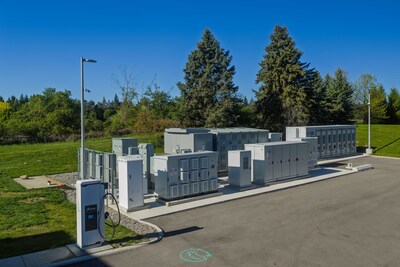
Detroit's Working Microgrid: Delta Electronics Goes Live with the Building Most Planners Were Still Drawing on Paper
Delta Electronics’ Detroit-area microgrid uses a 13.2 kV medium-voltage interconnection to operate as a grid participant—not just a customer, reporting roughly 50% lower grid draw. With an SST at the core coordinating 425 kW PV, 2.8 MWh storage, EV charging, and a 3 MW PCS, this is a live, utility-tied template for commercial buildings that import, export, island, and provide grid services.
By Keith Reynolds | Publisher & Editor, ChargedUp!
Most buildings still talk to the grid in one word: consume. This one holds a conversation. On April 30, contractors completed a 13.2-kilovolt medium-voltage interconnection between Delta Electronics' Plymouth, Michigan facility and the DTE Energy grid. Eighteen days later, Delta announced the commissioning of what is now the most complete commercial demonstration of distributed energy infrastructure operating under live utility conditions in the United States. It looks like a regular building. It behaves like a controllable node.
At a glance: Delta Electronics Microgrid specs
Interconnection: 13.2 kV medium-voltage tie to DTE Energy (distribution-level asset status)
Solar PV: 425 kW
Battery energy storage: 2.8 MWh (expansion planned with additional circuits)
Power conditioning system (PCS): 3 MW
Transformer: Solid-state transformer (SST), DOE-supported
EV charging: 8 Level 2 ports + 1 x 400 kW DC fast charger
Controls: Delta energy management system, monitored via in-house SCADA
Early result: ~50% reduction in grid-supplied energy at the facility
What makes the Delta Electronics microgrid different?
A medium-voltage interconnection plus an SST turns a commercial facility from a passive load into a dispatchable, islandable distribution resource that can import, export, and respond to utility signals.
Most behind-the-meter projects interconnect on the customer side, sized for consumption with limited export via net metering. The grid sees a quieter customer, not a partner. Delta and DTE selected a different architecture: the 13.2 kV MV interconnection treats the building like a distribution asset. The SST digitally routes power among PV, storage, EV chargers, building loads, and the utility, controlling voltage, frequency, phase, and direction in milliseconds. Conventional transformers can’t do this orchestration; they convert voltage, not behavior.
The result: a commercial building that can absorb or supply real and reactive power, participate in demand response, and island safely during outages—all under utility-grade controls.
Why does the Detroit (DTE) location matter now?
The Detroit metro faces significant load growth from industrial electrification and battery manufacturing, while DTE pursues major renewable additions. This site is a working testbed for how grid-interactive buildings change distribution planning, capacity procurement, and rate design.
DTE serves one of the Midwest’s most intense load-growth corridors and has committed to powering nearly 6 million accounts with wind and solar by 2042. Earlier this month, the utility advanced procurement for 1 GW of new Michigan-based renewables by 2029. This Plymouth deployment puts a grid-interactive building on the distribution network where interconnection policy, MISO market participation, and resilience pressures can all be studied in the open.
“Grid resiliency is quickly becoming one of the defining challenges for communities, businesses, and utilities alike… we are operating real energy infrastructure under real grid conditions to understand how systems respond, are controlled, and can contribute to grid stability.” — Austin Tseng, President, Delta Electronics Americas
Translation for commercial real estate: The building is now a regulated participant with revenue potential beyond rent.
How does a 13.2 kV interconnection change operations?
It elevates the facility from a meter point to a controllable node. Practically, that means different protection, coordination, and market options.
Operational shifts (what actually changes)
Protection and controls: Relay coordination, anti-islanding, and fault detection move to utility-grade standards. The SST and PCS handle fast ride-through, grid-forming, and black-start scenarios without tripping conventional gear.
Dispatch rights and obligations: The site can respond to DTE operational signals for real/reactive power, voltage support, and frequency response—opening doors to demand response and, where allowed, MISO participation.
Island mode done right: When the grid drops, the site forms its own stable microgrid. The SST and PCS maintain frequency and voltage, prioritizing critical loads and EV fast charging as policies dictate.
Export without net metering constraints: Exports are treated as a distribution resource rather than a retail billing adjustment, enabling compensation pathways outside retail net energy metering.
Implementation notes (what teams need to plan)
Early utility coordination: Engage distribution engineering during site plan review, not after. It shortcuts multi-year delays that have stalled many projects.
Right-size the electrical room: Design for SST-ready gear up front. Expect 70%–85% footprint savings versus conventional equipment when room geometry anticipates modular power electronics.
SCADA and EMS integration: Treat controls as critical infrastructure. Align data models and event timing with utility standards; test telemetry thoroughly.
Interconnection studies: Short-circuit, protection coordination, voltage flicker, and anti-islanding models must reflect inverter-based resources, not just rotating machines.
What are the income and valuation levers for owners?
Peak demand reduction, export/grid-services revenue, and a resilience premium to rent and cap rates, all variables outlined in our Energy-Equity Connection white paper, now become testable under real grid conditions.
Peak demand reduction: Capacity-based demand charges can represent 30%–50% of bills. A 2.8 MWh battery dispatched during peak intervals mitigates spikes, often yielding 15%–25% operating expense reductions for industrial/distribution/large office assets.
Energy export and demand response participation: The MV tie enables participation in DTE grid services and, potentially, MISO markets subject to program rules. Buildings gain a revenue line item, not just lower expense.
Resilience-driven valuation premium: Data center, healthcare, cold storage, and critical logistics tenants are willing to pay for uptime. Insurance and lenders are starting to price that resilience—raising attention and, in some cases, achievable rents.
The SST at Plymouth is DOE-supported, so near-term economics still rely on incentives. But the technical template now exists at commercial scale.
What should planners and permitting teams do differently?
You don’t need new zoning. You need earlier utility coordination, SST-ready room specs, and clarity on MV interconnection as a planning variable.
Electrical room design (2026–2027 submissions):Specify SST-capable layouts to realize 70%–85% gear footprint savings.
Medium-voltage interconnection in site review:Bring DTE (or your local utility) distribution engineering into pre-application meetings to cut months—sometimes years—off timelines.
Plan for resilience as an economic development tool:Streamlined permitting for distributed energy improves competitiveness for advanced manufacturing, data centers, healthcare campuses, and critical logistics.
For context from the field, see our APA National Planning Conference convened recap.
What to watch over the next six months
Performance data: Delta and DTE plan to publish operating results. The ~50% grid-reduction headline matters; the valuation impact sits in demand charge offsets and any grid-service revenues disclosed.
Replication: Delta operates globally. Watch for Plymouth’s template to appear at other North American facilities.
DTE follow-on: DTE’s procurement activity (including the May 26 pre-RFP webinar for 1 GW renewables) is a leading indicator. Watch for eligibility language referencing grid-interactive commercial buildings.
Related reading: Our May 20 feature on SST procurement details the transformer bottleneck now pacing commercial timelines.
Frequently Asked Questions
What is a solid-state transformer (SST) and why is it central to this microgrid?
An SST is a power electronics-based transformer that controls voltage, frequency, phase, and direction digitally. In Plymouth it routes solar, storage, EV charging, building load, and the utility tie in milliseconds, enabling export, fast islanding, and grid services that conventional transformers cannot coordinate.
How is the Delta Electronics microgrid connected to the grid?
It uses a 13.2 kV medium-voltage interconnection to DTE Energy. That distribution-level tie allows the facility to import, export, island during outages, and respond to utility dispatch signals under utility-grade protection and controls.
Does this model depend on incentives to pencil?
Today’s deployment includes a DOE-supported SST, so incentives materially improve near-term economics. However, the technical proof-of-operation at commercial scale is now established, and value streams (demand charge reduction, grid services, resilience premiums) can be assessed with disclosed performance data.
Can buildings outside Michigan replicate this architecture?
Yes, but interconnection rules and market access vary by utility and ISO/RTO (e.g., MISO, PJM, ERCOT, CAISO). The critical step is early coordination with the local utility’s distribution engineering and programs that accommodate export-capable, inverter-dominant resources.
What operational results has Delta reported so far?
Delta reports approximately a 50% reduction in grid-supplied energy at the facility post-commissioning, with additional performance data (peak shaving, export revenue, outage ride-through) expected to be published.
Do planners need zoning changes to permit systems like this?
No. The visible footprint remains typical (roof PV, a containerized battery pad, standard service yard). The differences are in electrical room design, MV interconnection planning, and permitting coordination with the utility during site plan review.
Next Steps
If you manage sites in MV-friendly territories, treat Plymouth as a pattern to test, not a one-off headline. Align teams early and document your own data trail.
Owners/Facility teams: Inventory demand charges and outage history; model a 2–4 MWh battery against your top 50 peak intervals.
Planners: Add an MV interconnection review step to pre-application meetings; right-size electrical rooms for SST-ready gear.
Utility liaisons: Establish telemetry and protection requirements upfront; plan for ride-through and grid-forming tests.
Finance: Separate OPEX reduction (peak shaving) from potential grid-services revenue; socialize resilience premiums with brokers and lenders.
For the NOI math and permitting playbooks, start with The Energy-Equity Connection white paper and our APA recap, then review our coverage on Solar, Storage and VPPs for performance updates.
Sources and further reading
ChargedUp! prior coverage
Four Years to a Transformer: The Bottleneck Now Setting the Pace of Commercial Real Estate (May 20, 2026)
The Energy-Equity Connection: How Distributed Energy Protects NOI and Cap Rates in 2026
