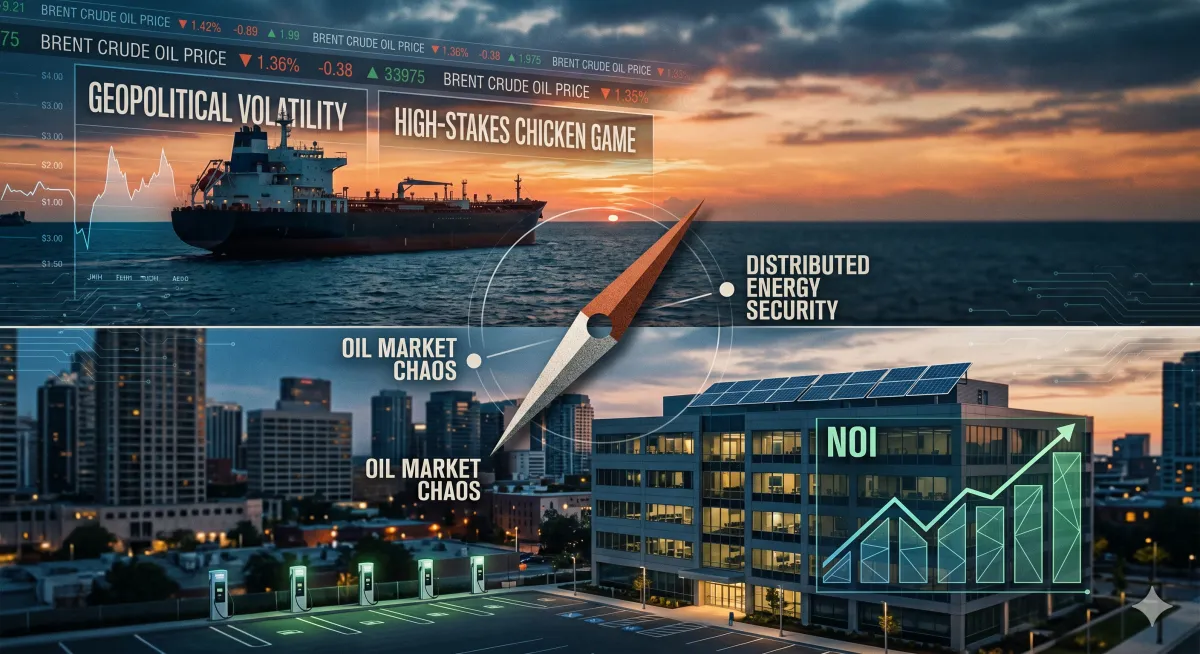
The Game of Chicken: Brent Crosses $117 as Talks Deadlock and Both Sides Calculate Who Breaks First
Wednesday morning, April 29: Brent jumps above $117 on reports the U.S. will extend the blockade. WTI crosses $104. U.S. retail gasoline hits a record $4.23 per gallon. Iran's rial hits a record low of 1.8 million to the dollar. Hormuz traffic remains at 5 percent of pre-war levels. Mohamed El-Erian's framing of the standoff as a high-stakes economic chicken game has reached the point where the market is pricing prolonged disruption rather than near-term resolution.
Section 179D and Section 30C deadlines now stand 62 days away. Iran has 12 to 22 days of unused storage before forced production cuts begin. The two clocks are running against each other, and the gap between them is where commercial real estate decisions get made.
By Keith Reynolds | Publisher & Editor, ChargedUp!
Mohamed El-Erian framed this week's diplomatic deadlock as a high-stakes economic chicken game with both sides calculating which one will yield first. As of this morning, Wednesday, April 29, the market has rendered its verdict on the timeline. Brent crude jumped above $117 per barrel after Reuters reported the United States may extend its naval blockade of Iranian ports, with WTI crossing $104 and U.S. retail gasoline hitting a record $4.23 per gallon. The S&P 500 and Nasdaq pulled back from recent record highs as investors began pricing prolonged supply shocks rather than the short-term risk premium that defined the first eight weeks of the war. (CNBC, Reuters, CBS News).
President Trump posted to Truth Social this morning urging Iran to get smart soon and sign a non-nuclear deal, expressing frustration over Tehran's refusal to reopen the Strait. Iran has continued to demand the blockade be lifted before nuclear program discussions can resume. The Iranian rial hit a record low of 1.8 million to one U.S. dollar this morning. The European Union is reportedly bleeding 600 million euros daily in conflict-related economic costs. Israeli strikes in southern Lebanon killed eight people Tuesday despite a shaky ceasefire, adding to regional instability. Each of these data points individually would warrant attention. Together, they describe a chicken game that neither side appears willing to lose, with the market now repricing the possibility that the standoff extends into Q3.
This is Part 9 of an ongoing series. The structural arguments for why distributed energy investment is the optimal response to this crisis regardless of diplomatic outcome are developed in full in the ChargedUp! anchor white paper, The Energy-Equity Connection, which Publisher Keith Reynolds presented Monday at NPC26 in Detroit alongside John Gaffigan of SuMapp and Max DiCapri of Yuasa. This installment focuses on what the Wednesday morning data tells us about the chicken game's likely duration, what Iran's storage clock means for the supply outlook through mid-May, and what 62 days to the June 30 statutory deadline means for owners working the math today.
Iran's Storage Clock: 12 to 22 Days Until Forced Production Cuts
Commodity intelligence firm Kpler released analysis Monday quantifying how close Iran is to running out of physical room for the oil it cannot export. Onshore inventories have swelled by 4.6 million barrels under the U.S. naval blockade to roughly 49 million barrels. Total nameplate capacity is 86 million barrels, or potentially 90 to 95 million barrels including several northern refinery tanks. Operational constraints, safety limits, and geography mean much of that headline capacity is not actually usable. Kpler's effective working storage estimate is closer to 39 million barrels. At current accumulation rates, Iran has 12 to 22 days of unused capacity remaining before it must reduce production further. (Bloomberg via Iran International, Türkiye Today citing WSJ).
The Wall Street Journal reported that Iran is using containers and disused tanks at southern oil hubs including Ahvaz and Asaluyeh, including tanks long avoided because of their poor condition, as the regime scrambles to delay forced shut-ins. Empty tankers are being repurposed for offshore floating storage in the Gulf, with several large tankers holding approximately 15 million barrels of capacity. Satellite imagery confirms Iran is now re-mobilizing retired supertankers for floating storage as the onshore window closes. Iran is even attempting to move oil by rail to China via links connecting Tehran to Yiwu and Xi'an, though Chinese teapot refineries that buy most Iranian crude operate on margins thin enough that higher transit costs may dissolve the trade entirely.
Kpler estimates Iranian crude production could fall from current levels by more than half, to between 1.2 and 1.3 million barrels per day, by mid-May if the blockade holds. Goldman Sachs estimates Iran has already curtailed up to 2.5 million barrels per day of crude output since the conflict began. Loadings of Iranian crude onto tankers have plunged roughly 70 percent since the U.S. blockade went into effect April 13, with Iranian exports falling from approximately 1.85 million barrels per day in March to roughly 567,000 barrels per day in recent weeks. Kpler reports it has not observed a single tanker successfully evading the U.S. naval blockade. (Business Standard).
Reservoir geology compounds the storage clock. Roughly half of Iran's oil fields have low pressure, leaving them vulnerable to longer-term production losses following stoppages, according to consulting firm Rystad Energy. Forced shut-ins at scale risk damaging reservoirs in ways that cannot be reversed simply by lifting the blockade. Israeli strikes on five phases of the South Pars gas field have already curtailed condensate and associated liquids capacity by 100,000 to 120,000 barrels per day for at least the next six months. The clock running on Iran's storage is therefore not just about the next three weeks. It is about whether forced cuts produce permanent damage to the country's medium-term productive capacity. The pressure on Tehran to make a deal is real. The pressure on Tehran to refuse to make a bad deal is also real, because the geological consequences of forced shut-ins outlive the political moment.
Why the Chicken Game Is Hardening Rather Than Resolving
El-Erian's framing has two implicit assumptions that Wednesday morning's data is testing. The first is that one side will eventually yield. The second is that the timeline of yielding is a wildcard ranging from a few weeks to several months. The reports this morning suggest the market is now pricing the upper end of that range. Reuters reporting that the United States may extend the blockade pushed Brent up more than 5 percent in a single session, taking out the resistance that had held through the Tuesday close at $111. The pricing logic is straightforward: if the U.S. extends the blockade, Iran cannot export, Iranian production must shut in, and the supply premium that has been building since February becomes the floor rather than the ceiling for crude prices through Q2 and possibly into Q3. (OilPrice.com).
Andy Lipow of Lipow Oil Associates estimated this week that even if hostilities ended immediately, returning Hormuz flows to normal would take four to six months because of mine clearance, tanker congestion, and the time needed to gradually restart production and refining. Lipow estimated oil prices would drop 10 dollars per barrel if the conflict ended tomorrow. The longer the standoff continues, the higher prices climb as global inventories draw down to critical operating levels. International Energy Agency Executive Director Fatih Birol has called the situation the largest energy crisis the world has ever faced. Hormuz traffic remains at roughly 5 percent of pre-war levels, with about 13 million barrels of daily oil production still effectively shut in due to the closure. (Hellenic Shipping News, The Dispatch).
Kpler's analysis adds a critical nuance. Despite the dire outlook for Iranian production, Tehran probably will not feel the full financial pinch for three to four months. Iranian crude cargoes typically take about two months to reach Chinese ports, and buyers have a further two months to settle payments. That financial lag means Tehran has near-term cash buffer that the storage data alone does not capture. The implication for the chicken game is significant: Iran is running out of physical storage faster than it is running out of money, and the regime may calculate that absorbing reservoir damage from forced shut-ins is preferable to accepting U.S. terms while financial reserves still hold. The 1.8 million rial-to-dollar exchange rate suggests the financial squeeze is real, but the lag between physical pressure and financial pressure is what makes the timeline of resolution genuinely uncertain. (investingLive citing Bloomberg/Kpler).
Reuters reporting that Tehran would accept reopening the Strait if Washington lifted the blockade, agreed to a revised framework for transit through Hormuz, and provided assurances against future military action, but wanted nuclear program discussions deferred, indicates that Iran is sequencing concessions to protect its strategic position. Trump's rejection of that proposal yesterday, paired with this morning's signaling that the blockade may be extended, indicates that Washington views the storage clock as working in U.S. favor and is prepared to accept additional weeks of $115 to $120 Brent to extract better terms. Both readings can be correct. The market this morning is pricing the duration that follows from both being correct simultaneously.
What Brent at $117 Means for Operating Economics
The April 29 morning print at $117.07 is now the marker that owners and underwriters need to reset against. The pre-war baseline of roughly 70 to 80 dollars per barrel was a 2025 number. The Brent strip for the next three to six months will be priced against the question of whether Iran shuts in production by mid-May, whether the U.S. extends the blockade further, and whether the Strait reopens within the four-to-six-month window Lipow describes. For commercial properties absorbing utility expense, the implications are now operating, not theoretical.
Three pass-through mechanisms turn elevated Brent into pressure on Net Operating Income. First, utility fuel adjustment clauses move with input costs. Most U.S. utilities recover fuel costs through monthly or quarterly riders that flow gas, coal, and oil price changes through to ratepayers with relatively short lag. The PJM capacity auction that cleared December 17, 2025 at the FERC-approved cap of $333.44 per megawatt-day was priced against pre-war assumptions; the supply premium now compounds the auction outcome rather than substitutes for it. PJM's own analysis estimates the auction adds roughly 70 dollars per month to the average residential bill by 2028. PECO filed a 429 million dollar rate hike. PPL settled at 275 million dollars including a 10-year Data Center Tariff template. Xcel Colorado is seeking 356 million dollars. Xcel Minnesota is seeking 574 million dollars over two years. The Center for American Progress rate case tracker counts 242 utilities pursuing increases that touch 111.5 million customers. None of those filings reverse on a ceasefire announcement. They compound on Brent staying above 100 dollars.
Second, gas-fired generation input pricing now reflects sustained Brent above 100 dollars. Roughly 40 percent of U.S. electricity generation came from natural gas in 2025, and gas prices in U.S. domestic markets typically lag global crude price moves by weeks to months but ultimately track them as LNG export economics arbitrage Henry Hub prices upward. Buildings on time-of-use rates, peak demand charges, or pass-through tariff structures will see those rates reflect the new input cost environment within Q2.
Third, transportation costs flow into operating expenses through almost every line item. Diesel-driven landscaping, snow removal, security patrols, supply deliveries, freight on tenant fit-outs, and maintenance vendor mileage all reprice. U.S. retail gasoline at a record 4.23 dollars per gallon this morning, up 1.25 dollars since the war began in late February, indicates the magnitude of the cost flow-through working into operating budgets through Q2 and Q3. Multifamily portfolios with significant tenant base in commute-dependent submarkets face indirect pressure as gasoline prices climb, even where the property does not directly absorb utility expense.
The mechanics by which utility rate exposure converts into cap rate pressure, and the structural case for distributed energy as the hedge, are developed in The Energy-Equity Connection white paper. The summary version: floating utility cost exposure compresses NOI, NOI compression flows directly into asset valuation through the cap rate, and the offset is converting the floating cost into a fixed capital investment underwritten with federal incentive offsets. Brent at 117 makes that math work harder than it did at 95.
The 62-Day Runway and What Closes the Gap
The Section 179D construction-start deadline and the Section 30C service deadline both land June 30, 2026. From this morning, that is 62 days. The math against the chicken game's likely duration is straightforward. If the blockade extends another four to six weeks before resolution, Brent stays above 100 dollars through Q2. The federal incentive window closes simultaneously. Owners that locked safe-harbor positions before mid-May capture both the federal incentive and the cost-hedge against elevated rates that arrive in Q3 and Q4 utility filings. Owners that waited for diplomatic clarity before acting will, by the time clarity arrives, have lost both.
Section 179D maximum at 5.94 dollars per square foot translates to 594,000 dollars on a 100,000-square-foot building. Section 30C commercial charging credit at 30 percent of installation cost up to 100,000 dollars per location supports EV charging infrastructure at multifamily, workplace, and retail properties. Section 48E Investment Tax Credit at 30 percent for behind-the-meter solar and battery storage continues beyond June 30 with new domestic content restrictions tightening through 2027. Restored 100 percent bonus depreciation under the One Big Beautiful Bill Act applies to qualified energy equipment acquired after January 19, 2025.
Wood Mackenzie's tracking of the U.S. transformer shortfall shows 30 percent for power transformers, 10 percent for distribution units, with two-to-four-year lead times. Power transformer prices are up more than 70 percent since 2019. Sites that have not ordered transformers cannot meaningfully safe-harbor against the June 30 deadline regardless of which way the chicken game resolves. The procurement window has to close in May, not June, for projects to clear the deadline.
Three strategies are already in motion across the ChargedUp! audience. The long-duration master lease structure, where third-party developers own the generation asset and the property owner takes rent while residents take lower energy costs, is replicable across multifamily portfolios in high-rate markets. Project-level solar-plus-storage positioned for incentive stacking with state-level program economics, NYSERDA NY-Sun in New York, ComEd Rider VPP in Illinois, Xcel Active Virtual Power Plant in Colorado, converts state-level program economics and the federal ITC into a single revenue stack. Virtual power plant participation through new utility tariffs converts idle assets into capacity revenue against the same wholesale pricing that drives the utility rate hikes. The common thread is the same: each trades optionality for certainty at a moment when certainty is the rare asset class.
The Energy-Equity Connection in Real Time
Our Energy-Equity Connection white paper, presented Monday at the American Planning Association's National Planning Conference in Detroit, traces a six-step chain from geopolitical energy shocks through commercial real estate equity. Step one is the external shock. The April 29 Brent print at $117.07 is step one in real time. Step two is the fuel adjustment pass-through into utility rates. The 242 utilities pursuing rate increases through state commissions are step two. Step three is elevated retail rates flowing through to NOI compression. The PJM pass-through beginning June 1, 2027 is step three for buildings in the PJM footprint. Steps four through six work through the cap rate and asset valuation over the next 18 to 24 months. The chicken game between the United States and Iran is the live test of the framework. Owners watching the framework play out from a distance are the ones absorbing the compression. Owners using the framework to position the portfolio are the ones converting it into a hedge.
The asymmetry El-Erian identifies, that Iran will probably yield eventually but the timeline is the wildcard, is the same asymmetry that makes the framework valuable. Owners cannot control when the Strait reopens. They can control whether their portfolios are positioned to absorb a sustained Brent premium without equity destruction. The properties that will hold value through the chicken game's resolution are the ones that locked behind-the-meter generation, secured transformer commitments, and stress-tested underwriting models against scenarios that include $115 to $120 Brent before the resolution finally comes. The 62 days between now and June 30 is when those positions get locked. The resolution of the war will come on its own timeline. The federal incentive window closes on the calendar's timeline. The two clocks are running against each other and the gap between them is where commercial real estate decisions get made.
The ChargedUp! Pavilion at NPC26 concluded yesterday in Detroit. The owners, planners, AEC and EPC firms, and utility staff who worked these questions together on the Pavilion floor through April 25 to 28 left the conference with concrete partnerships and project pathways. The Mideast Series will continue through the resolution of the Iran-U.S. standoff, with subsequent installments tracking how the pricing curve, the storage clock, and the behind-the-meter response combine to reshape commercial real estate operating economics through 2026 and into 2027. The chicken game will end. The structural shifts it has accelerated will not.
Sources and Further Reading
Bloomberg: Iran's Unused Oil Storage Shrinks to 22 Days or Less, Kpler Says
CBS News: Iran war live updates — Trump warning, Strait of Hormuz, Bab el-Mandeb threat, oil prices
CNN: Live news — Iran war peace proposal Trump (April 29, 2026)
CNBC: U.S. oil hovers near $100 on report Trump dissatisfied with Iran's proposal to open Hormuz
gCaptain: Aged oil tanker suggests Iran is bringing back retired ships
Hellenic Shipping News: Strait of Hormuz traffic still at just 5% of pre-war levels
investingLive: Iran has 22 days of storage left as naval blockade drives exports to near collapse
NBC New York: Live updates Iran war US Israel Middle East April 29
OilPrice.com: Brent Oil Prices Top $114 as Market Braces for Prolonged Disruption
Reuters: Trump urges Iran to sign deal after report suggests US may extend blockade
Türkiye Today citing WSJ: Iran stashing unsold oil in derelict tanks as US blockade cuts exports
Read our ongoing coverage of the Middle East conflict
Part 4: The Mideast Has Moved Goalposts Mid-Game. Stop Waiting for Clarity
Part 5: The Futures Price Is Telling One Story. The Physical Market Is Telling Another.
Part 6: April 8: The Deadline Passed. Here's What Changed and What Did Not.
Part 8: The Unstable Equilibrium Just Broke: Iran Seizes Three Ships as Brent Crosses $100
